Basic knife blade types
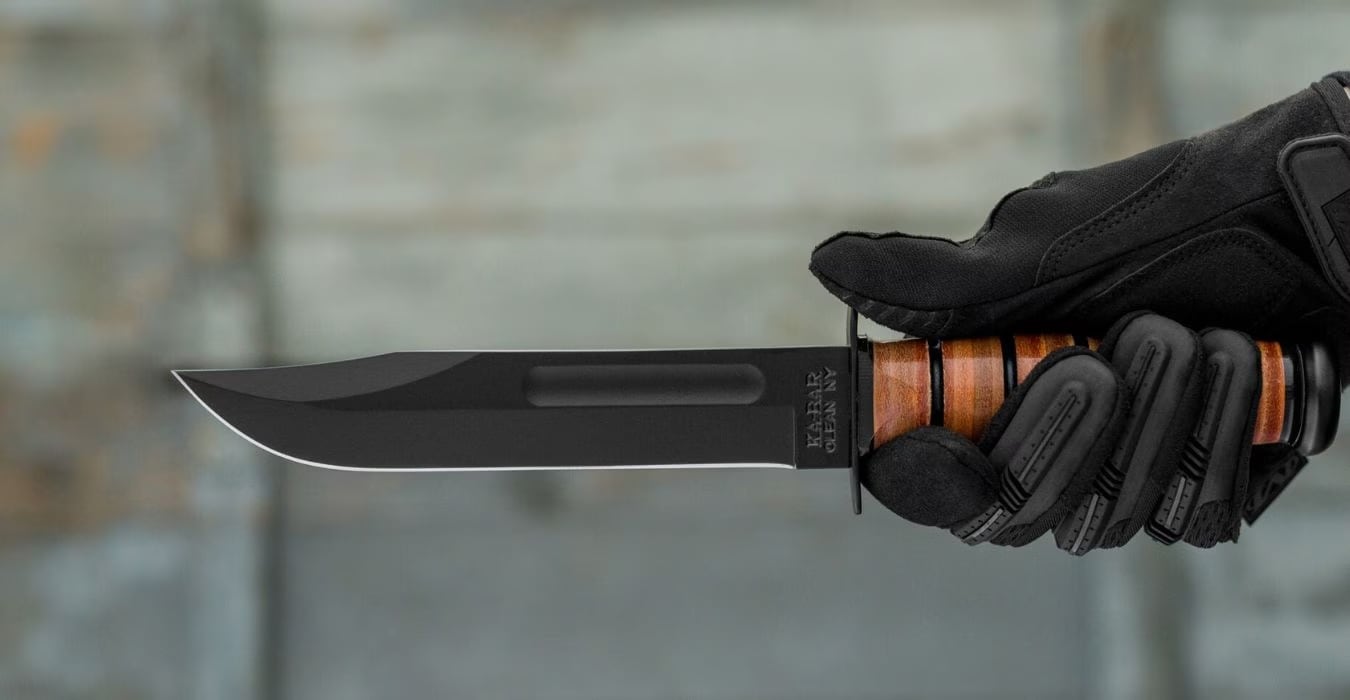
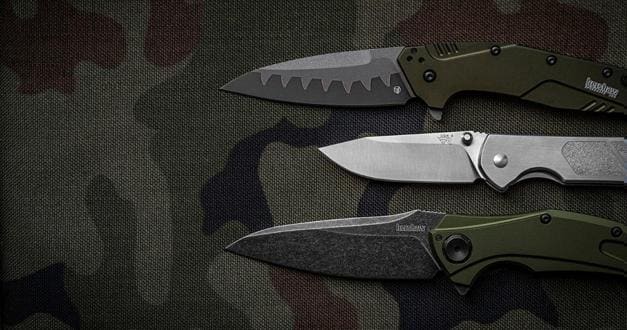
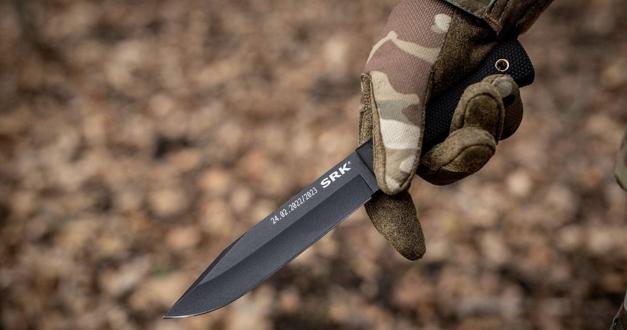
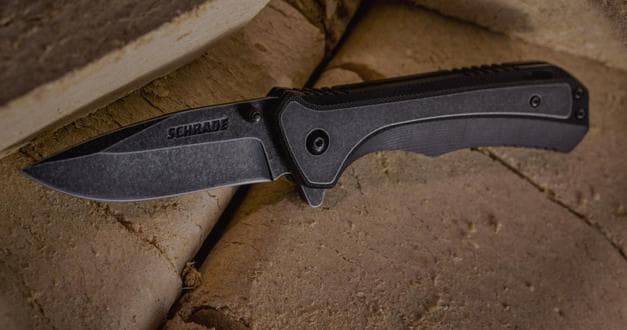
It's time to find out a few more things about knives - this time the article will explore the topic of knife blade types. We will briefly describe the types of blade types and where they are used - we hope this will make it easier to choose a knife for your needs.
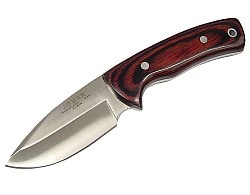
Drop Point
A blade with a clearly defined curvature of the blade belly and a gentle, slightly convex slope of the back of knife towards the tip. Due to its very good cutting properties and tip strength, this blade is commonly used in hunting and working knives for general use.
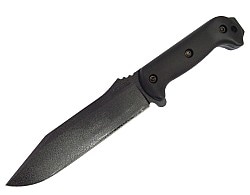
Clip Point
A blade similar to the Drop-Point blade, except that it has a slightly lesser curvature of the blade belly and a back of knife that descends toward the tip of the knife in a straight line. It features greater stabbing power, at the expense of slightly inferior cutting properties of the blade belly. This knife shape seems to strike a balance between the blade-tool and the blade-defense, which is why it is used in hunting, working and fighting knives.
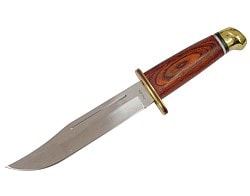
Bowie:
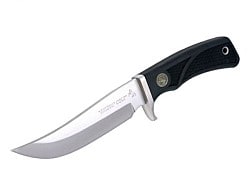
A blade with a well-defined curvature of the blade belly and a sharp, slightly convex slope of the back of knife toward the tip. Often the concave section of the back of knife near the tip is sharpened, or has the possibility of sharpening. Due to its very good cutting properties at the same time as stabbing power, this profile is commonly used in combat and general-purpose working knives. The disadvantage of Bowie blade is the relatively low strength of the tip.
Trailing Point
A blade with a strongly defined curvature of the edge and a marked belly of the blade, as well as a tip located above the back line. The advantage is that the section near the belly of the blade has very good cutting properties, hence this blade type is used in hunting knives designed for skinning. The disadvantage in this profile is the problematic control of the tip during operation and the difficulty of inflicting stabs in combat.
Recurve
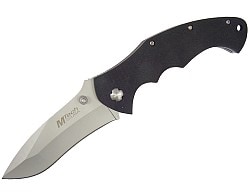
A head having a wave-shaped cutting edge. It can be a Drop-Point, Clip-Point or Bowie blade, with a concave section usually starting from the middle of the blade. It provides excellent cutting qualities due to the very distinct curve of the blade, which extends over a relatively large section. It is used in hunting knives, knives intended for combat and in working knives. Its disadvantages are the difficulty of sharpening on a flat stone, and the lower resistance of the blade to lateral loads.
Kukri
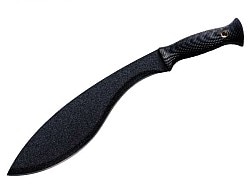
A blade of traditional knives used by Nepalese mountaineers, similar to the ancient Greek kopis and machaira blades. It is basically a long and wide recurve blade with a Drop-Point back. It is excellent for cutting and chopping. Its disadvantages are the difficulty of sharpening, and the lower cross-loading strength of the head.
Spear Point
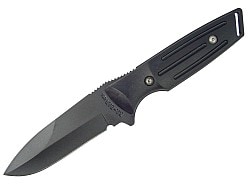
The type of blade with a symmetrical profile. The curves of the belly and the back are identical and form the tip. Unlike the dagger, the Spear-Point blade usually has only one cutting edge, the back of knife remains unsharpened, or sharp only on a short section from the tip. Its disadvantage is the small curvature of the blade belly and the relatively small width of the grind, which results in inferior cutting properties. It is used in combat knives and in small knives for everyday use.
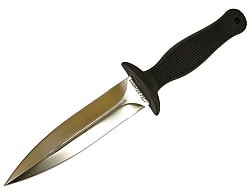
Dagger
A double-edged blade with a symmetrical profile. The curves of the belly and the back are identical and form a terminal tip. Both cutting edges are sharpened. Its advantages include excellent penetration capabilities and the ability to use the hilt in combat. Its disadvantages, as in the Spear-Point type, are the small curvature of the blade belly and the relatively small width of the grind, resulting in inferior cutting properties. It is used in military and tactical knives, as well as those designed for self-defense.
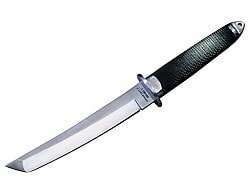
Tanto
Blades with a geometric profile, more or less referring to traditional Japanese swords and puginals. A geometric Tanto head has no belly but a sharp kink in the cutting edge, which forms an angular tip. The advantages of this design are the greater strength of the tip (the head reaches full thickness faster) and greater ability to inflict heavy damage in combat. The tip acts like a guillotine and the sharp kink of the cutting edge snaps the material being cut. The disadvantages of the Tanto blade are inferior penetrability, inferior cutting properties and an impractical blade tip for everyday use. It is used primarily in tactical knives.
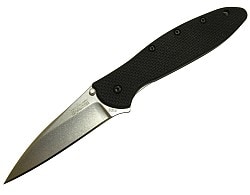
Spike
The head is shaped like a sharp, elongated triangle. It is characterized by a very sharp tip and minimal curve of the cutting edge. It is used in small knives for everyday use.
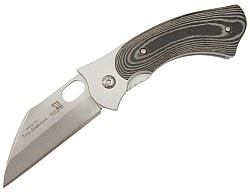
Warncliff
A blade resembling the shape of a hawk's beak, similar to the Spike type. The cutting edge is straight (sometimes even concave), the back of knife falling sharply towards the tip of the blade. It works well for planing and precision cutting. It is mainly used in small knives for everyday use.
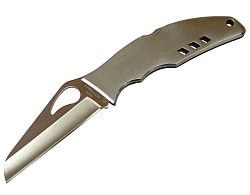
Sheepsfoot
A blade that has no blade belly, with a slightly arched or completely straight cutting edge and a convex, rapidly descending back. The lack of an aggressive tip makes a head with this blade readily used in rescue knives. It can be used to cut clothes, ropes and safety belts without the risk of injuring the rescued person with the tip of the knife.
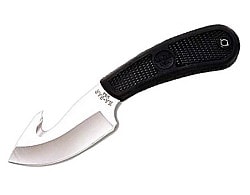
Hookblade
A head having a hookblade cutout on the back with sharpened edges. Most commonly used in hunting knives, where it facilitates gutting and skinning of hunted game. However, you can also find a similar design in rescue knives, which are designed to cut through any material with minimal risk of injury to rescuers.
Na infografice zaprezentowano rodzaje głowni:
Bowie
Geometria:
- wklęsły odcinek grzbietu przed czubkiem,
- wyraźna krzywizna brzuchu ostrza.
- dobre właściwości penetracyjne czubka,
- bardzo dobrze tnący brzuch.
Drop Point
Geometria:
- wypukły spadek grzbietu w kierunku czubka,
- wyraźna krzywizna brzucha ostrza.
Właściwości:
- podwyższona wytrzymałość czubka,
- bardzo dobrze tnący brzuch ostrza.
Clip Point
Geometria:
- prosty spadek grzbietu w kierunku czubka,
- przeciętna krzywizna brzucha ostrza.
Właściwości:
- kompromis między wytrzymałością, a ostrością czubka,
- właściwości tnące i penetracyjne w równowadze.
Tanto
Geometria:
- pełna grubość głowni zaraz za czubkiem,
- ostry kant zamiast brzucha ostrza.
Właściwości:
- bardzo wytrzymały czubek głowni,
- możliwość głębokiego cięcia kantem.
Dagger
Geometria:
- obosieczna głownia o profilu symetrycznym,
- stosunkowo niewielkie krzywizny ostrzy.
Właściwości:
- doskonałe właściwości penetracyjne,
- przeciętne właściwości tnące i wytrzymałość.
Spear Point
Geometria:
- profil grzbietu naśladuje krzywiznę ostrza,
- głownia podobna do sztyletu, lecz jednosieczna.
Właściwości:
- właściwości penetracyjne zbliżone do sztyletu,
- przeciętne właściwości tnące i wytrzymałość.
Karambit
Geometria:
- cała głownia mocno zagięta do wewnątrz,
- wyraźnie zaznaczony, ostry czubek.
Właściwości:
- możliwość głębokiego cięcia czubkiem,
- wklęsły odcinek działa jak sierp.
We hope that the above article and infographic will help you in your choice - please take a look at our offer of knives.