Alarm signals in Poland and warning messages – what do they mean?

The alarm signal system is used to warn and inform the population of dangers that may occur on Polish territory. In our country, there are several types of them, and for many people, they can be difficult to recognize.
In this article, we will discuss the types of alarm signals, alarms, and warning messages in Poland and explain their characteristic features, so that you will be able to recognize them in case of an emergency.
What are alarm signals and warning messages?
Alarm signals and warning messages (otherwise prejudice) are crucial elements of Poland's security system. Their primary function is to warn about various types of threats and to notify about actions that a citizen should take in emergency situations.
An alarm signal includes sirens and other means of immediately informing the population about a real threat. It requires protective measures to be taken. It is activated when there is a real threat to human life or health, e.g., in the event of contamination, natural disaster, technical failure, terrorist or military action.
A warning message is information about a possible threat. It gives time to prepare and exercise caution in situations where contamination, infection, or a natural disaster may occur. Its main purpose is to inform residents about the risk of danger before it is necessary to sound the alarm. Warning messages can be communicated via radio, television, press, the Internet, social media, or RCB alerts.
Remember:
An alarm is only declared when a threat has occurred – one example is an air raid alarm.
Warning messages about a possible threat are transmitted when such a risk exists.
How to recognize and respond to an alarm signal?
It is worth knowing that in Poland there is one way to declare an alarm, regardless of the threat present.
An alarm can be sounded, for example, in a situation where there is a threat of attack by means of air raid assault - an air raid alarm (air, anti-aircraft). In the case of other threats such as a terrorist attack, a massive bombing attack or others, the way of sounding and cancelling an alarm looks the same (only the name of the type of alarm changes).
| Method of sounding the alarm | |||
| Action | Acoustic signal | Announcement broadcast three times by the mass media (TV, radio, Internet) | Visual signal |
| Sounding the alarm | Modulated siren tone emitted for 3 minutes, at a ratio of 3:1 (3 seconds sound, 1 second pause) | “Attention! Attention! Attention! I declare an alert (give reason, type and other necessary information) ............ for ............................” |  Triangular yellow sign. In justified cases, another warning sign. |
| Alarm cancellation | Continuous siren tone for 3 minutes | “Attention! Attention! Attention! I cancel the alarm (give reason, type and other necessary information) ............ for ............................” | none |
What to do after an alarm is sounded?
If you hear the alarm signal emitted by sirens, do not panic. Make sure that drills have not been announced (the local population is notified in advance of drills).
The steps you should take after an alarm is sounded are:
-
turn on the radio or TV on your local radio/TV station (due to the risk of power cuts, it is advisable to have an emergency radio),
-
listen to the announcement and follow the instructions,
-
check the whereabouts of household members and loved ones - inform them of the danger,
-
if you are away from home contact your relatives - inform them of your whereabouts and how to contact you,
-
follow the instructions of the authorities,
-
remain calm, do not panic.




What kind of danger do the warning messages refer to?
Warning messages are information about a possible threat, issued when there is reasonable suspicion of contamination, infection, or danger resulting from a natural disaster. They may also be issued in situations such as severe storms or other dangerous weather conditions.
Warning of contamination risk
Contamination (radioactive, biological, chemical) can occur as a result of various factors, for example, such as accidents in nuclear power plants, hospitals, laboratories, industrial plants or in the transportation of hazardous substances. The announcement and cancellation of a warning of the possibility of contamination is as follows:
| Method of contamination warning announcement | |||
| Action | Acoustic signal | Announcement broadcast three times by the mass media (TV, radio, Internet) | Visual signal |
| Warning announcement | none | none “Attention! Attention! People within the area .................. about hr. ..... min. ..... contamination may occur................................. (type of contamination) in the direction of .......................” | none |
| Warning cancellation | none | “Attention! Attention! I cancel the warning of ...................... (type of contamination) for ..................” | none |
How to act in case of risk of contamination?
If you have heard a contamination warning in the mass media, do the following:
-
follow the instructions given in the announcements,
-
follow the instructions of the authorities,
-
turn off gas and electrical appliances,
-
close the windows and leave the apartment - go to the indicated place / in the indicated direction given by the authorities,
-
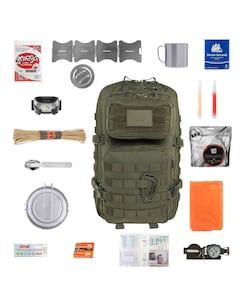
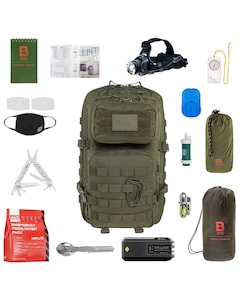
take with you: documents, food supplies, contamination protection and bandages, flashlight, blanket, battery-operated radio (it is advisable to prepare an evacuation backpack*),
-
if you do not have time to leave the apartment, seal the premises (doors, windows),
-
if you are in a public place - follow the instructions of the authorities, remember to protect the respiratory tract, face and skin,
-
avoid contact with objects left outside.
*Check out how to prepare an evacuation backpack in our advice “ How to pack Prepper's evacuation backpack?”
Infection risk warning
Infection risks can occur in an epidemic or pandemic, among other things - as in the case of the global SARS-CoV-2 (Coronavirus) pandemic. Although the public has had experience, it is worth remembering how to announce an infection message:
| Method of infection warning announcement | |||
| Action | Acoustic signal | Announcement broadcast three times by the mass media (TV, radio, Internet) | Visual signal |
| Warning announcement | none | The form and content of the infection warning message shall be determined by the authorities of the State Sanitary Inspectorate. | none |
| Warning cancellation | none | “Attention! Attention! I cancel the warning of ...................... (type of infection) for ...................” | none |
How to behave after an infection warning is announced?
If an infection warning has been announced, turn on the radio or TV on your local radio or TV station, read and follow the recommendations of the State Sanitary Inspection authorities.
Natural disaster and environmental hazard warning
In the case of natural disasters (for example, floods, fires, meteorological anomalies), currently the most common form of notification and warning to the public is a text message sent by the RCB. However, it is useful to have knowledge of how to announce a warning in a more traditional form:
| Method of natural disasters and environmental contamination warning announcement | |||
| Action | Acoustic signal | Announcement broadcast three times by the mass media (TV, radio, Internet) | Visual signal |
| Warning announcement | none | "Information about the threat and how residents should proceed ................... (type of threat, expected time of occurrence and guidelines for residents)." | none |
| Warning cancellation | none | “Attention! Attention! I cancel the warning ...................... (type of disaster) for ..................” | none |
In the event of a natural disaster emergency, follow the recommendations of the authorities - turn on the receiver and set to a local radio station or TV station. Among other things, you may need to secure items on balconies or in backyards, secure animals (including livestock) or evacuate.
Alarm levels in Poland – what are they and what do they mean?
In addition to hazard alarms and warnings about the possibility of their occurrence, it is also useful to become familiar with alert levels. Alert levels suggest the nature and risk of a given threat. In Poland, we distinguish alarm levels and CRP alarm levels.
Alert levels and CRP alert levels are introduced by the Prime Minister in consultation with the minister responsible for internal affairs and the head of the ABW (Internal Security Agency). In urgent matters, the introduction is the sole responsibility of the minister responsible for internal affairs in consultation with the head of the ABW, informing the Prime Minister immediately.
The alert level and CRP alert level may be introduced on the entire territory of the state or part of it or applied only to specific objects. With regard to persons, institutions and state infrastructure outside the borders of the Republic of Poland, the degree is introduced if the threat may affect the listed persons and entities.
Alert levels and CRP alert levels
Alert levels are introduced when there is a threat of a terrorist event or when such an event occurs.
The CRP alert level is introduced if there is a threat of a terrorist event that affects the ICT systems of public administration bodies or the critical infrastructure of the state, or in the event of such a threat.
There are four alert levels in Poland:
First level – ALFA
The first alert level ALFA can be introduced when information has been obtained about the possibility of a terrorist event, the scope and type of which cannot be predicted.
Second level – BRAVO
The second alert level BRAVO is introduced when there is an increased and predictable terrorist threat, but the exact target of the attack has not been determined.
Third level – CHARLIE
CHARLIE level can be introduced if:
-
an event has occurred that confirms the probable target of a terrorist attack that harms the security/public order or security of the Republic of Poland or the security of another state or international organization, which poses a potential threat to the state,
-
reliable and confirmed information has been obtained about a planned terrorist attack on the territory of the Republic of Poland,
-
credible and confirmed information has been obtained about a planned terrorist attack, the consequences of which may affect Polish citizens residing outside the country, or foreign Polish institutions or foreign Polish infrastructure.
Fourth level – DELTA
The highest, fourth DELTA alert level is introduced in a situation:
-
of the occurrence of a terrorist attack that causes: a threat to security/public order or a threat to the security of the Republic or a threat to another state or international organization, which constitutes a threat to the Republic,
-
of obtaining information indicating advanced preparations for carrying out a terrorist attack on the territory of the Republic of Poland*,
-
of obtaining information indicating advanced preparations for carrying out a terrorist attack on Polish citizens, institutions or infrastructure outside the country*.
*The information obtained must indicate the imminence of a terrorist attack.
Alert levels were declared in Poland during, among other events:
-
NATO 2016 Summit in Warsaw - an ALFA alert level has been introduced in the capital's area.
-
The 31st World Youth Day 2016 in Krakow - an ALFA alert level has been imposed throughout the country.
-
The dynamic geopolitical situation in Ukraine and increased traffic on the border in 2022 introduced the BRAVO alert level in the Lubelskie and Podkarpackie provinces.
CRP alert levels were introduced in Poland during, among other events:
-
The 2019 European Parliamentary elections introduced the BRAVO-CRP alert level throughout the territory.
-
The UN Digital Summit - IGF 2021 in Katowice, Poland, introduced the ALFA-CRP alert level throughout the country.
-
The tense situation in the region in 2022 is the first time the CHARLIE-CRP alert level has been introduced throughout the country.
Alarm signals in Poland - what should you remember?
The most important thing to do when an alarm or warning of a possible emergency is announced is to avoid panic. Remember to follow the announcements made by the authorities - from the announcements you will get information about the current status of the development of the situation, as well as the steps to be taken.
It's also a good idea to prepare in advance for a possible evacuation, so that if you have to leave your apartment or house, you can be sure that you have everything you need with you and that the process goes smoothly. What to prepare for an evacuation? Check out our post about an evacuation backpack - you'll find all the information you need.