


The backpack is great! A big advantage is that the side pockets can be detached if you don't need the full capacity, so you can leave one or two pouches at home and attach something else. The bottom compartment is nice too—you can easily stow something there that you don’t want in the top section.
Wisport Raccoon Backpack 85 l - MAPA

Shipping: Immediately
€387.85
Top
- description
- technical data
- features and technologies
- Reviews
- Goes Well With

€387.85

Wisport Raccoon Backpack 85 l - MAPA
Large military-survival bug out bag with a robust 85-liter capacity. Constructed from exceptionally durable, tear-resistant Cordura material. Features an adjustable carrying system, multiple compartments, and a MOLLE/PALS system, with reinforced seams for enhanced strength. Perfect choice for extended expeditions, long journeys, and tactical scenarios.
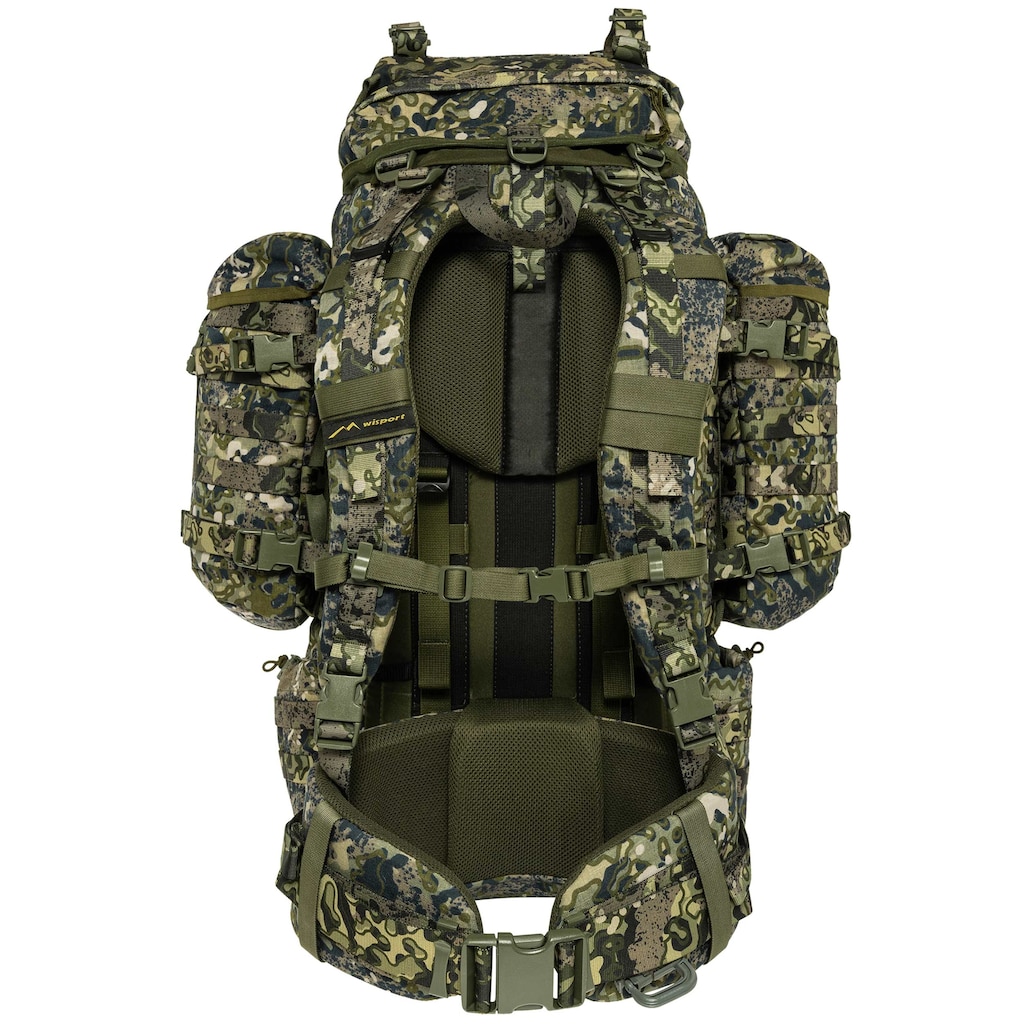

Adjustable carrying system
Constructed with an aluminum frame, the bag integrates an adjustable carrying system (FAS Plus Ergonomic) that can be customized to fit the user's specific body shape and height. Broad, adjustable hip and chest belts feature certified ITW NEXUS and Duraflex buckles for secure fastening. This robust setup ensures exceptional rigidity for the bag and provides optimal comfort when transporting heavy gear. Enhanced back ventilation is achieved with the addition of spacer mesh, promoting airflow during warm conditions.

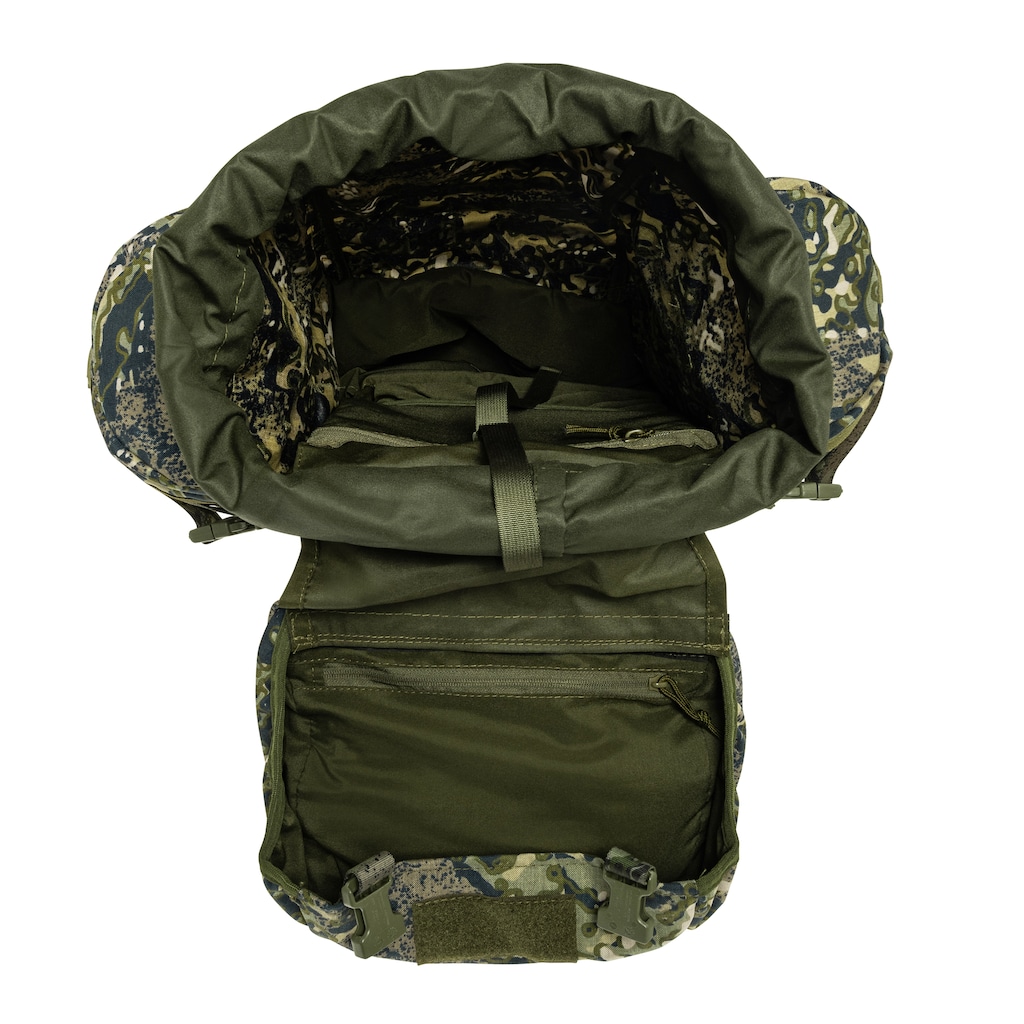
Spacious main compartment and additional pockets
The main compartment features a dual-section design, divided by an internal collar into a lower portion (1/3 of the overall capacity) and an upper portion (2/3 of the overall capacity). A removable flap situated at the bottom allows access to gear stored in the lower section. On both sides, additional 9-liter pockets provide space for organizing smaller equipment. The main compartment secures from the top with a soft collar fastened by a zipper and held in place with a stabilizing strap. The pack’s lid integrates two pockets: an exterior top pocket and a large inner pocket for added storage. For convenient single-handed transport, a side handle is included.

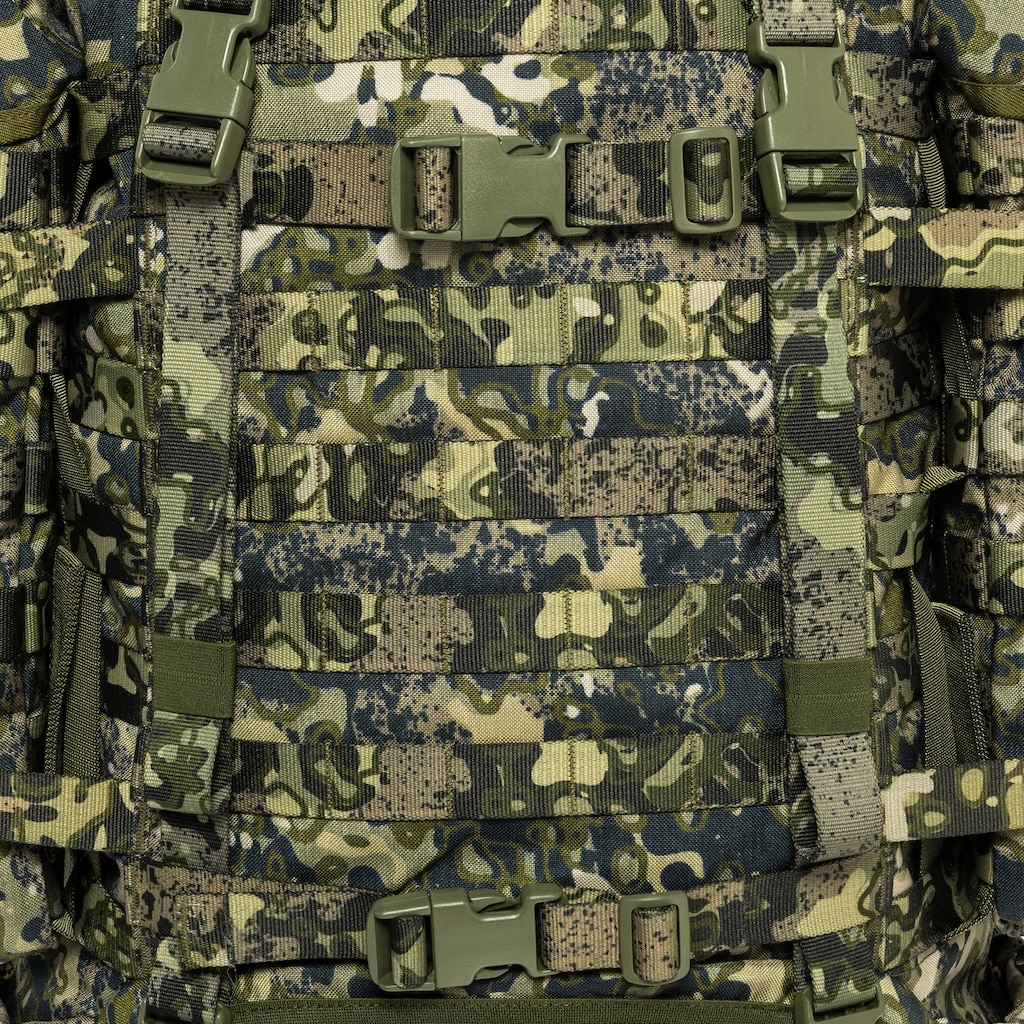
MOLLE/PALS system and external straps
A MOLLE/PALS system is integrated into the bag, enabling the attachment of extra pouches and gear. Enhanced versatility is provided by external straps with buckles, ideal for securing items such as a sleeping pad or sleeping bag.

Hydration pocket and rain cover
A dedicated sleeve for a water tank is integrated into the bag. Plastic hooks located on the straps secure the hose firmly in place. A discreet pocket at the base of the bag contains a rain cover for extra protection.

Main features
- Constructed from robust Cordura fabric
- Features reinforced seam stitching
- Equipped with ITW NEXUS and Duraflex closure buckles
- Integrated MOLLE/PALS webbing system
- Built on a lightweight aluminum frame
- Comes with an adjustable load-carrying system
- Fitted with wide hip and chest support straps
- Includes a pocket featuring a rain cover
- Contains a dedicated hydration bladder sleeve
- Offers two large-capacity side pockets
- Main compartment can be separated into sections

MAPA camouflage
The MAPA camouflage pattern was developed by Maciej Dojlitko, a graduate and current researcher at the Faculty of Architecture and Design at the Academy of Fine Arts in Gdańsk, known for his work including the Theory of Deconstruction of Visual Communication. Tools for Designing Military Camouflage (Gdańsk 2015). This cutting-edge design, underpinned by robust theoretical and experimental foundations such as computer-based analysis of countless terrain photographs, drew interest from experts and manufacturers of military clothing. In 2017, MAPA camouflage was showcased for the first time during the International Defense Industry Exhibition in Kielce as the camouflage solution for the Dromader gear and uniform system by Maskpol, a member of the Polish Armaments Group. Conceived primarily for the Territorial Defense Army, the MAPA camouflage also emerged as a potential new standard for all branches of the Polish Armed Forces with the aim of succeeding the wz.93 camouflage. To date, however, MAPA has not been adopted as the official camouflage pattern of the Polish military.
The main features of MAPA camouflage in the basic forest variant
- 6 colors forming layers reminiscent of map elevation contours
- Color palette fine-tuned for operations within Central European forests
- Incorporation of three-dimensional illusions and anamorphic effects
- Biomorphic designs echoing the forms found in natural vegetation
- Highly contrasting elements simulating interplay of light and shadow
- Disruption of the wearer’s silhouette via a macro-scale layout
- Micro pattern integration delivering color noise for enhanced concealment
The MAPA pattern presents a compelling alternative to leading modern camouflage systems such as PenCott, MultiCam, Kryptek, Flecktarn, or Finnish M/05. In some aspects, it surpasses them in advancement and is also more effective in replicating the characteristic colors of Central European forests from late spring through early autumn.
Militaria.pl is the exclusive distributor of Wisport in Poland.
Wisport is a Polish brand with more than 30 years of experience in manufacturing high-quality backpacks and outdoor gear. The company has earned recognition among both survival and tourism enthusiasts, and professionals from the military, uniformed services, and rescue services. Wisport products stand out for solid workmanship, modern designs, and the use of proven technologies. The brand's backpacks are developed in cooperation with specialists, which allows them to offer well-thought-out solutions such as FAS+ carry systems, durable materials such as Cordura®, or waterproof protective coatings. The range includes tactical, trekking, and urban models, adapted to a variety of user needs.
| Color/camouflage | Camouflage |
|---|---|
| Main compartments fastening | Flap |
| Dedicated laptop pocket | No |
| Molle/pals compatible | Yes |
| Mesh spacer | Yes |
| Number of compartments | 2 |
| Dimensions | 650 x 380 x 340 mm |
| Capacity | 85 l |
| Number of pockets | 5 |
| Camouflage | MAPA |
| External equipment attachment option | Yes |
| Compatible with hydration system | Yes |
| Raincover | Yes |
| Waist strap | Yes |
| Chest strap | Yes |
| Weight | 3300 g |
| EAN | 5906729502861 |
| Brand | Wisport |
| Main material | 100% 500D Cordura |
| EAN |

Cordura
Cordura is a material woven from durable nylon fibers, developed by DuPont. The structure of the material provides lightness and abrasion resistance, as well as weather resistance. Due to its properties, Cordura is widely used in tactical equipment.

System MOLLE
MOLLE (Modular Lightweight Load-carrying Equipment) is a system for attachment of tactical equipment, used for example in backpacks or tactical vests. It provides the possibility of flexible and modular placement of various accessories and pockets, which allows personalization and optimal adjustment of the item to the specific needs of the user. It is widely used by the military, special services and survival and outdoor enthusiasts.

ITW Nexus Buckles
High-quality buckles and fasteners distinguished by their durability and reliability. Made of durable materials such as nylon or polyamide, used in products that require a solid and secure fastener, providing security and comfort.

Duraflex buckles
Duraflex is a type of high-quality buckles, fasteners, snaps and accessories made from durable materials such as polyamide, acetal, as well as metals and metal alloys. They are resistant to weather conditions, UV radiation and mechanical damage. Duraflex products are used for fastening, connecting and adjustment in backpacks, bags, clothing and military equipment.

FAS Plus Ergonomic (Military)
FAS Plus Ergonomic system (FAS+ Military) used in Wisport backpacks is a fully adjustable, aluminum frame-based carrying system that allows for precise adjustment to the body shape ensures comfort and stability while walking, improves ventilation thanks to the use of AIR NET mesh foam, and allows for quick detachment or reversal of the hip belt for use with tactical accouterment.
Reviews with photos

Review summary
Automatically prepared based on reviews
Number of reviews: 56
-
-
A very nice option for someone looking for a large backpack that could still be made smaller thanks to the five side pockets. The quality of workmanship, as befits our manufacturer, is great.
-
I was considering a smaller backpack, but I finally chose this Wisport because you can detach the side pouches, and the core of the backpack itself can be packed conveniently.
-
The backpack is great for longer trips. Very spacious, and thanks to the distribution of capacity into additional side panniers, you can easily spread out and organize your gear.
-
Overall, it seems to be decently made, but I'm only worried about the amount of loose threads. In this price range, I didn't expect there to be so many, since backpacks costing 200-300 PLN can be better quality-controlled before sale. On the plus side, it's comfortable to wear and the pockets are well positioned.


-
I've been a Wisport fanboy for years. Basically, I own only backpacks from this company. And I really praise them. The materials are of very high quality, the stitching is great. You need to remember that because of this, the backpacks themselves are quite heavy. Durability must have its weight, after all. Sure, there are more functional backpacks, but for me, it's especially important that it was made in Poland. I recommend all products from this manufacturer.
-
First plus - entirely made in Poland. That’s important to me. Quality of workmanship and materials? WOW!!! The material, stitching, the configurability thanks to the MOLLE/PALS system and more. Very well-thought-out solutions. Interesting camouflage. Comfortable hip belt, shoulder straps, and chest strap. The ability to adjust on many levels and of many elements. I will buy a few more items in this camouflage and be ready for real challenges. I hesitated for a long time before buying. I analyzed my needs. Now I know that was a waste of time. I gained a few KKS points ;) Order handling? Speed of light ;)
-
K... Review confirmed by purchase

The Wisport Raccoon 85l backpack in wz.93 camouflage is absolutely amazing. Very solid, spacious and incredibly comfortable. It works great even during long marches with a heavy load.
-
The backpack is a great suggestion as a base for longer trips. It fits a lot of things and is easy to pack because it has two large side pockets and a flap at the bottom. It also has many mounting options.
-
The backpack is a great suggestion as a base for longer trips. It fits a lot of things and is easy to pack because it has two large side pockets and a flap at the bottom. It also has many mounting options.
-
Wisport helps me limit my backpack hoarding, because with this one I can detach the sides and have a much smaller backpack, which I would very much like to have separately ;) It's excellent and I sincerely recommend it.
-
K... Review confirmed by purchase
A very good and spacious backpack for the money. Quality is almost flawless (minor protruding threads), the stitches are straight without breaks or deviations from the norm. The backpack's capacity (85L) is given for the main compartment plus the side pockets.
-
The backpack has nothing but advantages. It's very spacious, well-made, made in Poland, and competitively priced compared to branded backpacks. You will definitely be satisfied with it.
-
The backpack with side pockets is so spacious that sometimes it actually feels too roomy ;) Additionally, the pockets can be removed and you get a handy, about 50L backpack for shorter trips. I definitely recommend it.
-
A very spacious and versatile backpack, mainly because you can detach the side pockets if you don't need the full capacity. I definitely recommend it.
No reviews

