Shooting glossary - learn the terminology of air rifles
For novice shooters, the number of names and terms associated with windpipes can sometimes be overwhelming. For this reason, we have compiled a glossary to familiarise you with the various terms relating to windsock shooting.
Aiming instruments - i.e. a musket and a brush
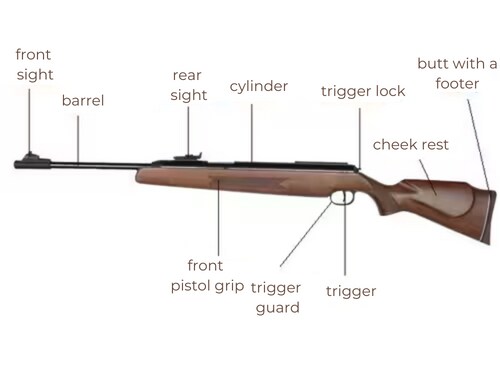
Aiming instruments is the name used to describe a wide range of different sights. These range from basic, so-called open sights (a bow tie on the barrel and a pin barrel) to professional optical sights with a device for measuring the distance to the target (e.g. a laser rangefinder). The basic sighting devices, which are commonly used in every basic pistol and carbine, are the bow tie and the pin barrel.
A bow tie is a front sighting device. It can be found mounted (usually permanently) at the end of the barrel. Shells are also sometimes removed or tilted, for example, in order to mount another sight. The bow tie can also be closed (enclosed) or open. For precision shooting, a bow tie requires the use of the rear sight, which is a rear sighting instrument located most often above the barrel or on an axis parallel to the barrel.
Correct alignment of the bow tie and the pinkie is the basis of accurate shooting.
Trigger - or trigger tongue
The trigger commonly referred to as the trigger is the external component of the trigger mechanism. Pulling it, for example, releases the firing pin (e.g., a firearm), the cock (e.g., a black-rifle) or the spring (e.g., a spring-loaded wind gun), or even the string (a crossbow).
Other concepts such as “way” and “force” are also associated with the trigger. Trigger path, is the distance at which the movement of the trigger tongue initiates a shot, and trigger, is the force required to break the resistance of the trigger, followed by a shot.
Windsock bed
It's made of wood or synthetic material the part of the weapon that most often supports the barrel (along its entire length or part of it), sometimes a lock. A part of the bed may be a fore grip (including horizontal) and a flask.
Baka of the windlass - otherwise known as the cheek pad
It's flask component protruding above its outline. It serves as a cheek rest both to improve comfort when aiming and to increase the stability of the weapon in an arm - butt - fore grip - hand configuration.
Spike - trigger guard
It is used to trigger tongue protection, preventing it from being accidentally pressed. If the trigger were exposed, any snagging on clothing, the edge of a holster, or fingers gripping the weapon could result in an unplanned shot. Therefore, the holster is the most basic safety feature.
Optical and collimator sight
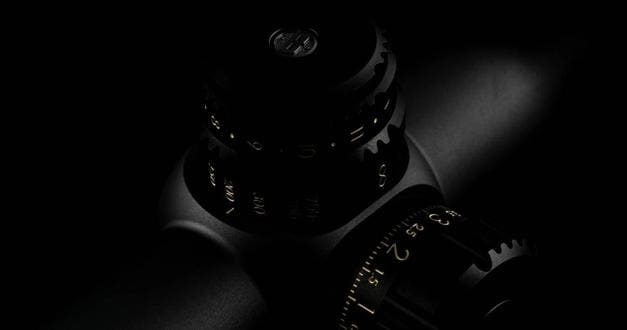
Optical sight (also known as a spotting scope) is a optical instrument for easy aiming and precise shooting. It has a prism system and most often offers magnification expressed in zoom multiples (e.g., 3× means three times magnification). A spotting scope labeled, for example, 3-7×20 is characterized by a variable, adjustable magnification (from 3 to 7 times) and a 20mm objective lens.
A collimator sight is an instrument that uses a weak laser or diode which applies a luminous mark to the prism located in the viewfinder. Looking through a collimator sight, therefore, we can track the target with a luminous spot located in the center of the image seen in the sight. A collimator sight is deceptively similar to an optical sight, but it usually does not offer any magnification, so it is not as precise.
Trigger lock - safek
Trigger lock is a mechanism that immobilizes the trigger tongue and prevents it from being pulled down, and thus protecting against the firing of an uncontrolled shot. At the same time, it should be borne in mind that the trigger lock does not protect against firing as a result of, for example, a strong shock associated with dropping the weapon.
The trigger lock can be automatic (which automatically locks the trigger when, for example, the windgun spring is pulled) or adjustable (each time the shooter must block it himself).
Pistol grip
A vertical component of the butt (rear) or bed (front) that allows the weapon to be held with the hand without excessive bending of the wrist.
Flask
Part of a bed or an independent piece, either fixed or folding (sideways, on top or underneath, sometimes telescoping). It is used to support the weapon against the shooter's shoulder and stabilize the barrel. It is intended to facilitate stable aiming and ensure comfortable folding for firing.
Stop pin
Element (mostly) of mounting clamps preventing them from sliding along the mounting rail. Such sliding (sliding of the mount along the mounting rail) can be caused by strong recoil of the weapon and, even if it is not noticeable to the shooter, can cause the aiming instruments to be decalibrated.
Threaded barrel
It allows to put the projectile in a rotary motion, which improves its flight (ballistic) properties - loudness, accuracy, as well as penetration properties.
Take a look at the photo showing the components of the windbreaker - see where the parts are located!
Double Action, Single Action and Double Action Only - what is it and how are they different?
SA (Single Action)
It's single-action trigger – pulling the trigger releases the cock, which, by hitting the valve, causes the release of a portion of the gas necessary to push the shotgun shell out of the barrel. The cock has to be tightened manually (with a finger or with the movement of the breech) or it is tightened with the blow back mechanism. The short path of the trigger and its lightness mean that the shooting adventure should begin precisely with pistols with the possibility of pre-tensioning the cock.
DA (Double Action)
It's double-action trigger – pulling the trigger releases the previously tensioned cock (as in SA) and tensions the cock in the first phase of the trigger tongue movement and releases it in the second phase. This means that after the shot is fired, the cock is taut and ready for the next shot. One does not encounter trigger mechanisms in which the two cycles could be disconnected. It is worth noting that a long trigger travel is associated with greater trigger resistance, which to an inexperienced shooter can complicate aiming.
DAO (Double Action Only)
It's double-action trigger only – there is no possibility of tensioning the cock in any other way than making the entire, long path of the trigger. Such a solution is very beneficial for safety, since there is no possibility of preparing the gun for a shot and carrying it, for example, with a tightened cock. Models with a DAO trigger require the shooter to be more accurate when simultaneously aiming (keeping the target in line with the sighting instruments) and pulling the trigger, the path of which cannot be shortened, as is the case with a DA trigger, by manually tightening the cock.