Dangerous tools vs. necessary defense in Poland
Defence accessories and certain everyday objects available on the market can significantly increase our chances in a clash with an aggressive attacker. At the same time, many people wonder whether defending themselves with effective accessories, including dangerous tools, will not become a source of serious legal problems for them.
Facts and myths about necessary defence
Will the use of a telescopic baton, tonfa-type truncheon or knife in a situation of necessary defence automatically mean that it exceeds its permissible limits?
A number of myths have grown up around these issues that have unfortunately become quite entrenched in the public consciousness, with the most popular claims being:
-
"The tool of defence must correspond to the tool of attack - if someone attacks you with their hands, you can only defend yourself with your own hands, otherwise you are overstepping the boundaries of necessary defence."
-
"While it is permissible to carry dangerous tools on you, if you use them against a person, it will automatically be considered a crime, even though you were the party attacked."
Under Polish law, both of the above claims are false!
The basis for assessing the proportionality of the defence to the threat is not the mere fact of the use of certain objects or methods of defence, nor the effect of this defence on the attacker per se. This assessment always depends on a detailed analysis of the specific event, and such factors as the dynamics of the attack and the general course of events over time, as well as the degree of threat and the value of the threatened goods are decisive. Those wishing to explore the issue of the permissible limits of the defence in more detail are referred to the article on the scope of a necessary defence.
Here we will only recall that we must act within the limits of necessity, and therefore the intensity of our action should be no greater than is necessary to ensure that the attack in question is effectively and safely repelled. In addition, the necessary defence must be a response to an unlawful direct attack, i.e. it must commence when the attack is already in progress or when there is no doubt that it is about to take place and, just as importantly, it must end when the attack ceases. On the other hand, the use of dangerous tools against the attacker is perfectly permissible in certain circumstances and does not in itself constitute an overstepping of the boundaries of necessary defence - even if the attacker used only physical force, i.e. colloquially speaking bare hands.
This position is confirmed by numerous case-law, including judgments of the Supreme Court. Let us take a look at some of them.
Supreme Court judgments on the defence of necessity
In a way, the classic, most quoted Supreme Court judgment is:
Judgment of the Supreme Court of 11 July 1974 (VI KRN 34/74):
"An actor acting in necessary defence is allowed to use such means as are necessary to repel the attack. The use, especially in moderation, of a dangerous instrument shall not be deemed to exceed the limits of necessary defence if the person repelling the attack did not have at his disposal at the time any other means of defence which was less dangerous but equally effective, and it appears from the circumstances of the incident, in particular from the preponderance on the part of the attackers and the manner in which they acted, that the attack endangered the life or health of the attacked person."
We would add that the verdict related to the knife defence and that the attackers only attacked with their hands.
It is also worth looking at another judgment, which explicitly reminds us that necessary defence is not a chivalrous duel:
Judgment of the Supreme Court of 9 March 1976 (III KR 21/76):
"No one can be denied the right to hold the assailant at a distance with such an object as comes to hand, even if the assailant attacks with his bare hands. For the attacked person is not obliged to get into a brawl with the assailant and expose himself to blows in order to give the defence undertaken by him against a direct unlawful attack the form of an equalised duel."
The verdict concerned the metal tube defence.
Similar theses are also included:
Judgment of the Supreme Court of 23 July 1980 (V KRN 168/80):
"... the institution of a necessary defence allows for the use of any necessary means of defence to repel a direct and unlawful attack on life or health, and the type of instrument used may not prejudge the exceeding of this defence if the person repelling the attack did not dispose of another less dangerous instrument".
Judgment of the Supreme Court of 11 February 1982 (II KR 8/82):
"The mere manner of defence against a direct, unlawful attack, even if it consists in inflicting on the assailant a number of blows with a dangerous instrument, does not lose the characteristics of being commensurate with the danger of such an attack and does not prove that the limits of necessary defence have been exceeded if an assessment of the totality of the circumstances constituting the danger of that attack leads to the conclusion that it endangered the life or health of the attacked person, who had no other effective means of repelling the attack."
More contemporary judgments of the Supreme Court and the Courts of Appeal continue this interpretation:
Judgment of the Court of Appeal in Katowice of 15 October 1998 (II AKa 53/98):
"The accused's grabbing of the knife, which was the only object capable of stopping her attacker, cannot be treated as the use of a disproportionate means of defence. For it follows from the nature of the necessary defence itself that the counteraction by which a real, unlawful attack is repelled must be effective in order to achieve its purpose. Such effectiveness occurs when the counteraction contains an element of superiority over the unlawful action in question".
Judgment of the Supreme Court of 09 April 2002 (IV KKN 289/99):
"A person acting in necessary defence may use such means as he considers necessary in the particular circumstances to repel the attack. These may even include dangerous tools (...)".
Judgment of the Court of Appeal in Białystok of 22 November 2005 (II AKa 168/05):
"The person defending himself against an attack has the right to use such an object as is able to ensure that he is able to repel the attack, even when the attacker uses his bare hands. It is permissible to use a dangerous instrument even when the attacker uses only physical force, as long as the attacked person has no other means of defence.
When attacking a legally protected good, and in particular when making an attack on the health or life of another person, the attacker must expect a defence from the attacked person and such a defence as will be necessary to repel the attack, so the attacker should take into account any consequence that may occur as a result of such an attack, with the risk of suffering damage to health or even loss of life."
Judgment of the Court of Appeal in Katowice of 20 June 2007. (II AKa 168/07):
"Any person attacked and defending himself against an attack has the right to use such an object as will assist and ensure his repulsion, even in such a situation where the attacker uses only his hands. It is therefore permissible to use a dangerous instrument, such as a knife, even if the attacker uses only physical force and the attacked person has no other means of defence."
Judgment of the Court of Appeal in Kraków of 14 June 2006. (II AKa 85/06):
"The person acting in necessary defence is not obliged to inform the attacker that he will defend himself, in particular by using a knife. Adopting such a condition for defence would practically cancel out the right of defence of the attacked person, as it would put the attacker, who, after all, does not usually warn the attacked person that he will attack him, in a privileged position."
Judgment of the SA in Łódź of 7 February 2006. (II AKa 4/06)
"The institution of a necessary defence allows for the use of any necessary means of defence to repel an attack on health or life, with the tool and means of defence to be used within the limits of necessity. "Necessity" is relative to the attack, both as to the manner and means of defence, with the limit of the "necessity" of the defence being set by the "repulsion" of the attack and not by the harm to the attacker."
The above examples of case law leave no doubt - when acting in necessary defence, we have the right to use dangerous objects, including metal batons and sharp tools, and the harm suffered by the attacker, in itself, does not prejudge the question of exceeding the limits of necessary defence.
Legal tools for self-defence
A separate issue is to consciously choose the right tool that we plan to carry with us in case of an emergency.
Firstly, let us choose accessories that we can possess legally. Although the fact of illegally possessing a particular object does not exclude the possibility of using it in necessary defence and does not affect the assessment of the defence itself, in parallel we may be in separate trouble because of the charge of possessing without a permit objects which are weapons within the meaning of the Act. In the case of an illegally possessed castet or imitation baseball bat, this is a misdemeanour, but in the case of illegal possession of a firearm, it is a serious offence punishable by imprisonment of up to eight years.
Secondly, if one assumes the carrying of only one universal tool of defence, it is worth choosing among such accessories which will be effective and at the same time as non-lethal as possible (non-lethal weapon). Although the mere effect on the attacker does not determine that the limits of indispensable defence have been breached, if we kill the attacker and the whole of the incident indicates that we have in some way breached those limits, we will face very serious charges. Particularly in a situation where we are defending goods of a much lower value than human life and health, it is worthwhile to refrain from resorting to means whose use involves a high risk of deprivation of life. The law does not require us to maintain an absolute ratio between the value of the goods defended and the value of the attacker's goods that are harmed by our defensive action. However, when the disproportion between these goods is blatant, this may weigh in favour of a court finding that we have exceeded the limits of necessary defence.
So let's look at three tools: knife, expandable batons i pepper sprays. They can all be acquired and possessed completely legally, without permits or other formalities.
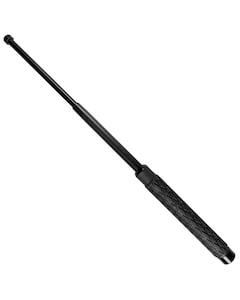
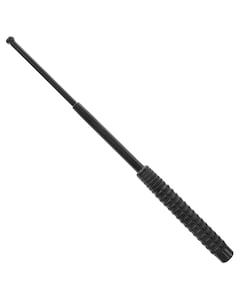

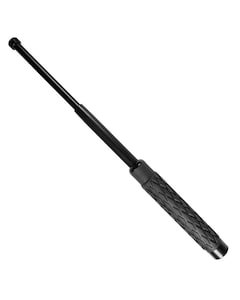


A knife is a discreet, convenient to carry, everyday tool that can be used as a very effective means of defence at any time. Unfortunately, any defence with a knife risks causing death to the attacker - often an inconspicuous cut or stab damages vital organs and the consequences are difficult to predict. It is therefore worth making the practical assumption that it is a means of defence whose use is justified virtually only in the same situations that would justify the use of a sharp firearm. In addition, as with firearms, the effective use of a knife in necessary defence requires not only a certain degree of dexterity, but also - and perhaps above all - composure and the ability to make quick, correct decisions under high stress. A lack of decisiveness due to the fear of harming an attacker can result in our knife being taken from us and used against us with tragic consequences. On the other hand, an overly aggressive defence, e.g. involving multiple knife blows to the chest, which is not difficult to do in emotions, will almost certainly be considered by the court as exceeding the limits of necessary defence.
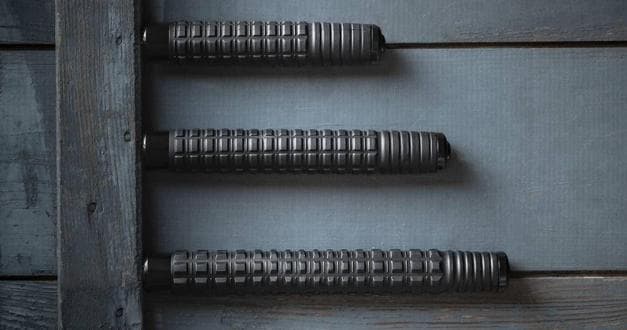
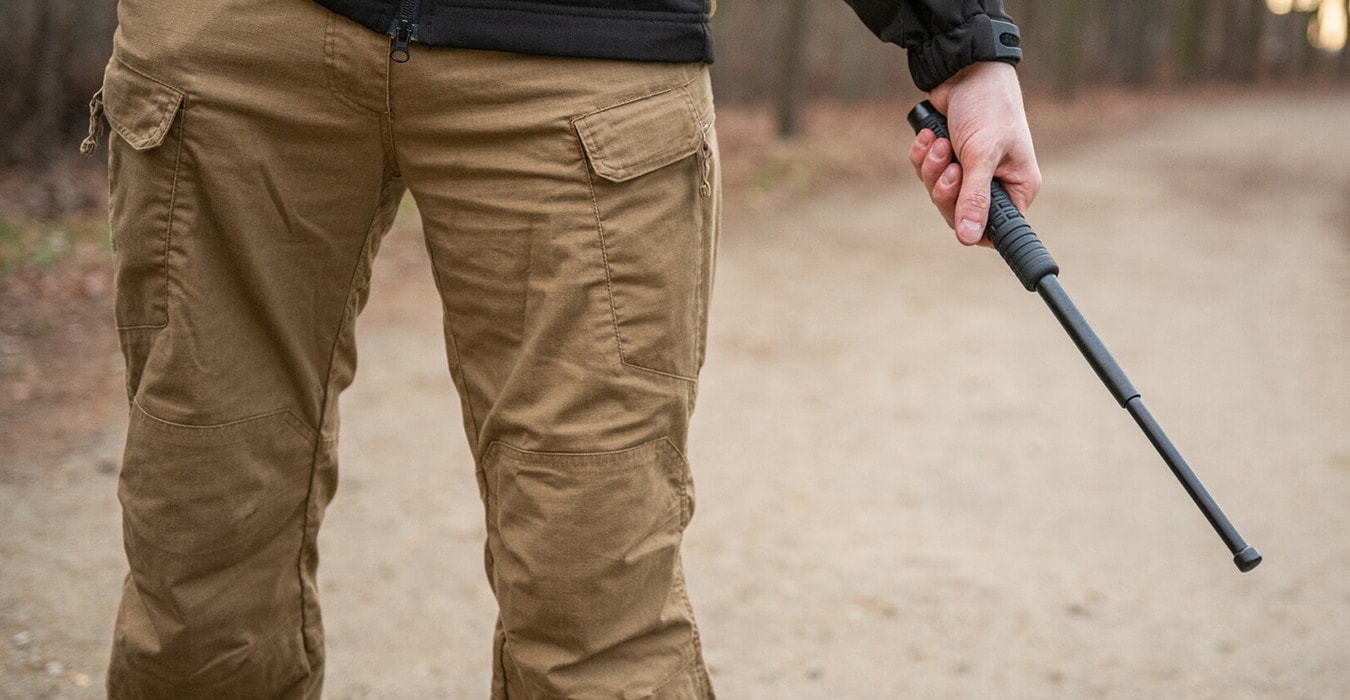
A much more sensible and versatile defence tool will be a telescopic baton. By striking the muscular parts of the body with it, we will cause acute pain and thus paralyse the attacker's movements, but this will not endanger his life. On the other hand, thanks to its high potential for inflicting damage, the telescopic baton will also allow us to emerge unscathed from more serious oppressions - including those that will necessarily require us to cause serious damage to the attacker's health. The kubotan also offers a similar spectrum of possibilities.
At the far end of this scale is pepper spray - effective, yet its use is almost entirely free of the risk of causing permanent injury. Unfortunately, in some situations pepper spray may not be sufficient, for example against extremely determined attackers who can only be stopped by physically violating their musculoskeletal system. This is mainly due to the fact that pepper spray always acts with a certain delay and for the first 2-3 seconds the attacker does not feel the full effects of its action.
Let us also keep in mind two important actions that are associated with the institution of necessary defence:
-
If we have caused grievous bodily harm to the assailant, we are obliged to provide the assailant with first aid or call for such assistance after ensuring that the danger has completely disappeared
-
If we have made sure that the danger has completely disappeared, it is worth calling the police to give a statement. Refraining from contacting the police may work against you when later assessing the incident. It is a good idea to give a statement even if the attacker has fled.