Legality of telescopic batons - expert opinions and the law in Poland
Telescopic baton vs. self-defense tool
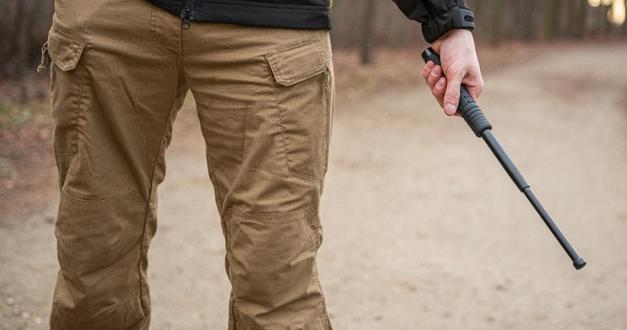
Telescopic batons, also known as baton-type batons, have been some of the most popular defense accessories in Poland for several years. In addition to professional users, such as security agency employees, it is possessed by public transport drivers, cab drivers, adepts of hand-to-hand combat courses and thousands of others who feel the need for an effective self-defense tool. At the same time, due to the vague concepts and generally unfortunate definitions contained in the Law on Weapons and Ammunition, some people refrain from purchasing a telescopic baton, fearing committing an offense for illegal possession of a white weapon.
In our opinion and in the opinion of many experts, including institutional experts, these fears are unfounded - typical telescopic batons are not weapons and can be possessed without a permit, registration or other formalities, which we will try to justify below.
Is a telescopic baton a dangerous tool?
The primary source of the aforementioned concerns is Article 4(1)(4) of the Law on Weapons and Ammunition, raised in discussions, according to which, among other things:
"[...] - batons having a tip of heavy and hard material or containing inserts of such material" are considered white weapons for which a permit is required,
- counting them among those "tools and devices whose use may endanger life or health.[...]"
On this basis, can typical telescopic batons ending in a small metal cap with a rounded shape be considered weapons? A literal reading of Article 4 of the Law on Arms and Ammunition leads to such a conclusion, because since the subsection devoted to imitations of a baseball bat considers wood to be a hard and heavy material, all the more so will such a material be most of the metals used to make batons and their ends. However, experts disagree with such a simplistic and therefore very broad interpretation, and point out that the legislator had in mind a completely different type of baton than typical telescopic batons.
Telescopic batons vs. the law
Among other things, in the expertise of Central Forensic Laboratory of the Police Headquarters (CLK KGP) No. H-L-II -3317/3040/03, dated 20.05.2003, we can read:
"[...] The two telescopic batons tested do not have inserts made of heavy and hard material inside the sleeves. The batons end on both sides with metal plugs, which are made of hard material, but this material is not heavy in relation to their other components.
The telescopic batons in question, in light of the provisions of the Law on Arms and Ammunition of May 21, 1999, do not meet the requirements of a tool and device whose use may endanger life or health, as they do not have a termination made of heavy and hard material and do not contain inserts made of such material."
Also in a more recent opinion No. L-Z2-5185/5090/13 dated August 2013. The Central Forensic Laboratory explicitly states that typical telescopic batons are not weapons:
"[...] The telescopic baton in question cannot be categorized as one of the above-mentioned devices, since the plug that is the end of the baton is of the same diameter as the center sleeve and was made of the same material as the other metal parts of the baton. The baton under evaluation in its unfolded state can be compared with a metal rod of variable diameter. In the opinion of the Central Forensic Laboratory, telescopic batons (including the telescopic baton in question) do not fall under the provisions of Article 4(1)(4) of the Law of May 21, 1999 on arms and ammunition."
The Military Institute of Technology and Armament in Zielonka also takes a similar position. So what "batons having a tip of heavy and hard material or containing inserts of such material" could the Polish legislator have had in mind? Let's give the floor to Tomasz Maczuga, deputy head of the Police Interventions Unit at the Legionowo Police Training Center:
"[...] a weapon in the form of a truncheon having a tip of heavy and hard material or containing a cartridge of such material can be spoken of only if this material has been placed in the truncheon for the purpose of making it dangerous to life or health - in the event of its use against a person."
Thus, in addition to the possibility of a literal reading of Article 4(1)(4) of the Law on Weapons and Ammunition, there is also a purposive interpretation in practice, indicating the necessity of the presence of such a termination of heavy and hard material, which significantly affects the parameters of the baton as an instrument capable of endangering life or health. In such a view, it is not enough to have any termination of heavy and hard material or an insert of such material in order to classify a baton as a white weapon within the meaning of the Law on Weapons and Ammunition. Let's now look at a typical telescopic baton and its end.
Construction of the telescopic baton
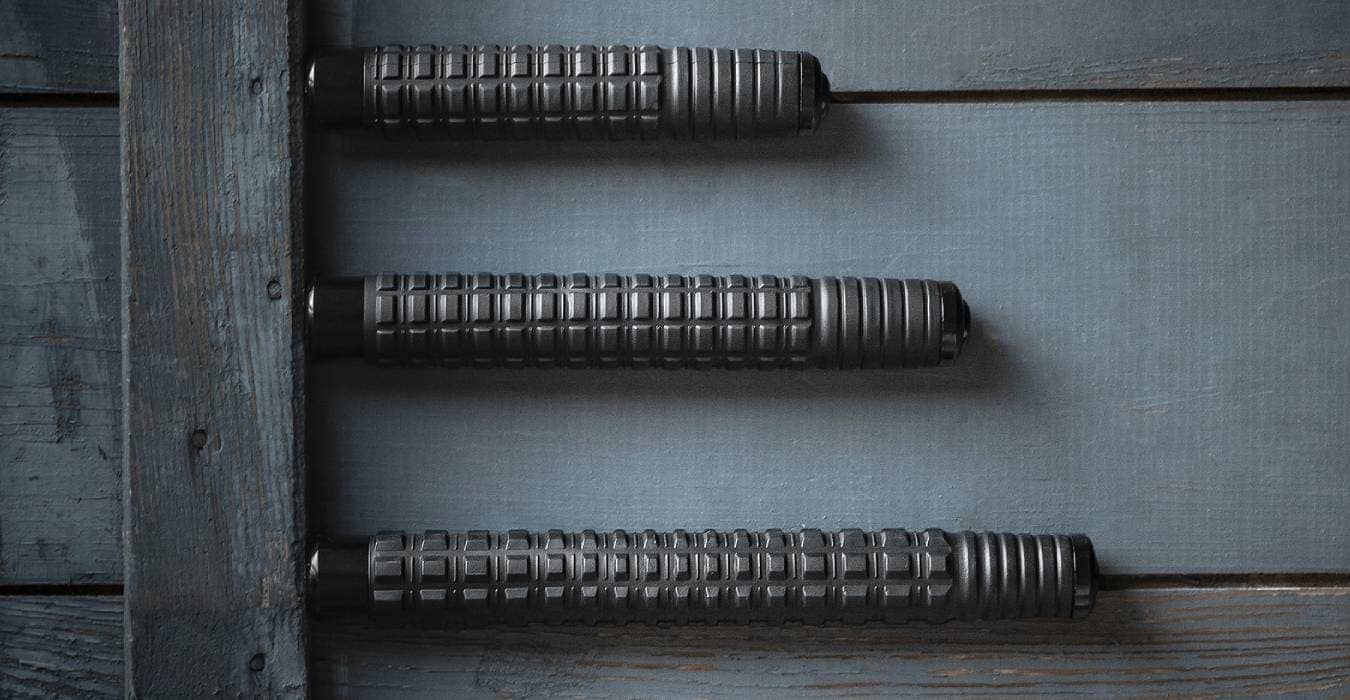
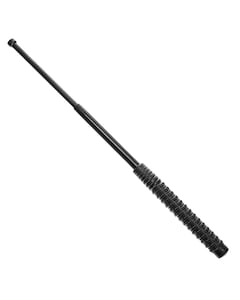
First of all, looking from the technical-design side, the small metal cap that forms the end of most telescopic batons does not serve to increase the injury that results from the blows inflicted by the baton. It is a design element that, first and foremost, is intended to protect the end of the last segment of a telescopic baton from damage when it is folded over by hitting hard ground - without it, we would be hitting the edge of the last segment's tube, which could lead to chipping or cracking. Secondly, designers' intentions aside, the weight of the cap is usually negligible in relation to the total weight of the baton and its effect on the balance, and thus the kinetic energy of the baton's end, is negligible. In addition, especially in the case of hardened batons, the cap has a lower hardness than the segments of the baton and without it the end of the baton would be even harder.
Considering the above rationale, the content of the cited expert reports of the Central Forensic Laboratory, which examined, among other things, ESP batons, becomes fully understandable.
On the other hand, batons that certainly qualify as white weapons within the meaning of the current Law on Weapons and Ammunition are batons with such a filling or tip of heavy and hard material, which are made to increase the baton's ability to cause injury. In most cases, these will be batons with a design other than the classic rigid telescopic baton. It is worth mentioning the military spring truncheons with a combat end from the World War I era, as well as the leather truncheons with a slapjack / blackjack type lead insert or spring truncheons with a brass weight, popular in the criminal milieu of the interwar period, as well as all sorts of rubber, plastic or wooden truncheons with the center of gravity clearly shifted towards the hard end, which, in addition to the purposive interpretation, is also clearly indicated by the historical interpretation.
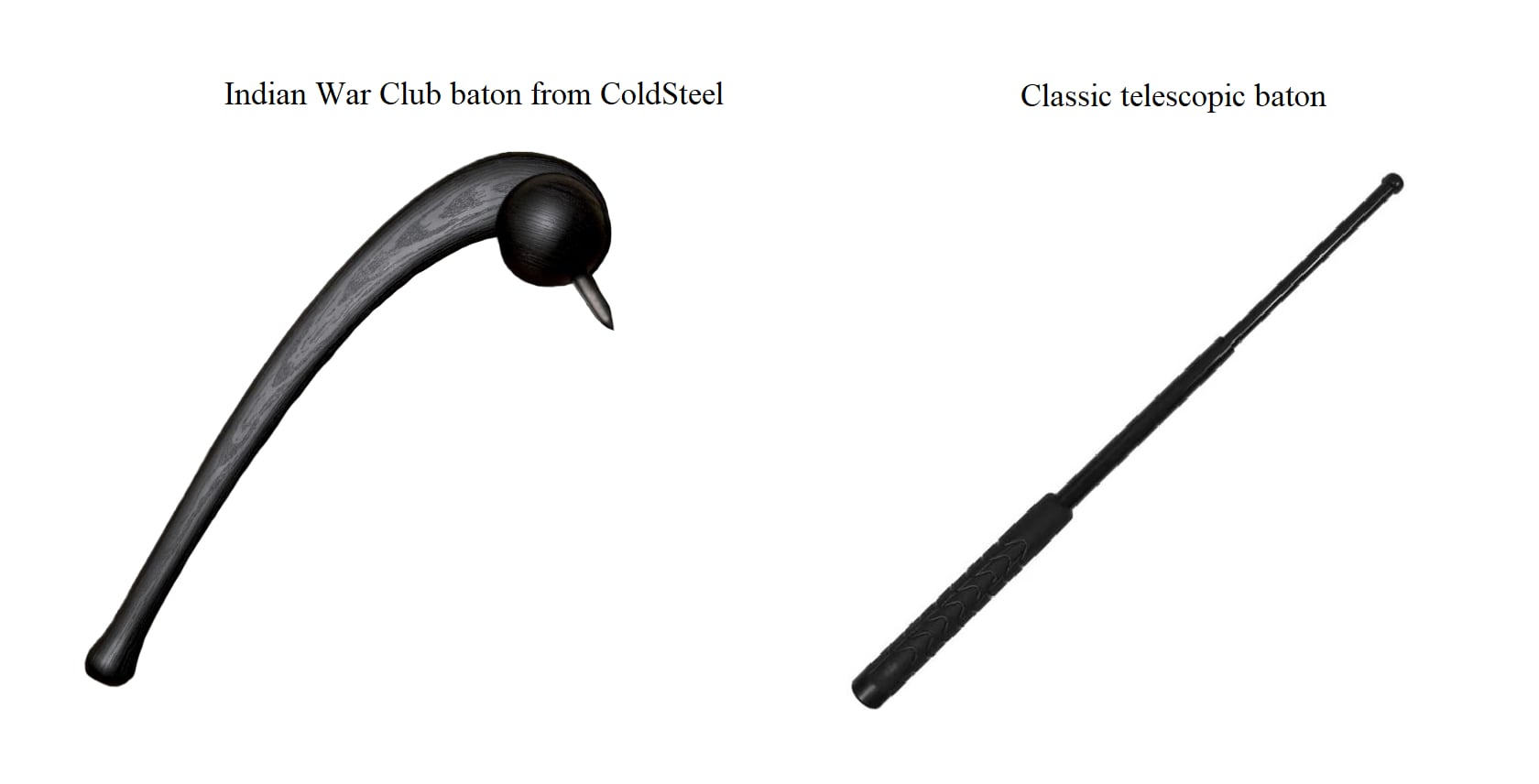
In addition to the above-mentioned flexible batons, another model example of such a baton only in the rigid type is the Indian War Club produced as a functional replica by Cold Steel. It can be seen below on the left. Now let's compare this baton to the classic telescopic baton, seen below from the right - the difference in design assumptions is all too obvious.
Legality of telescopic batons - summary
To sum up - a typical telescopic baton (tempered or non-tempered) can be legally purchased, owned and carried on a daily basis without a permit, registration or other formalities. However, we should remember to use it against a person only within the limits of necessary defense or in a state of higher necessity. Similar caveats apply to the possible use of a telescopic finger against animals.
This study would not be complete without mentioning the regulation of telescopic batons in uniformed services and armed security formations. Telescopic batons are now an increasingly popular means of direct coercion, gradually displacing tonfa-type batons. The legal authorization to use telescopic batons as a PPE is held by a number of formations listed in Article 2. of the Law on Direct Coercion and Firearms, namely:
-
Police
-
National Protection Service
-
Military Police
-
Border Guard
-
Specialized Armed Protective Formations
-
Customs and Fiscal Service
-
Prison Service
The possession and use of a telescopic baton as a means of direct coercion is subject to strict rules. First of all, it must be an official baton, and therefore formally received. It is unacceptable to use a privately purchased baton for official activities. Secondly, the rules regulate in detail under what circumstances an officer may use a baton, as well as what striking and blocking techniques are permissible and what are prohibited.
Only in a situation of an unlawful attempt on life or health may officers and security personnel use a telescopic baton to the full extent of the capabilities that this tool offers. In addition, the use of a privately purchased baton is permissible in such circumstances.
Regulations governing the use of service batons, including telescopic batons, as MPCs are contained primarily in the May 24, 2013 Law on Direct Means of Restraint and Firearms.




Footnotes
1.Unlike illegal possession of firearms, which is a crime punishable by imprisonment for up to 8 years, unauthorized possession of small arms is at most a misdemeanor punishable by a fine or arrest. These issues are regulated by Article 51 of the Law on Arms and Ammunition. We deliberately used the phrase "at most," because it is not entirely clear whether the unauthorized possession of objects that are, in the sense of the Weapons and Ammunition Act, white weapons can itself be considered an offense described in Art.51(1) of the said law. E.g., in the judgment of the Supreme Court of 19.08.2009. (II KK 178/09) concerning, among other things, possession of a knuckle-duster (without a permit), we can read: "The mere possession [...] of a tool or device, the use of which may endanger life or health, does not realize the elements of an offense of this type [...]. The case also raises doubts about the type of weapon questioned at the defendant's home and whether all the secured items constitute weapons within the meaning of Article 4(1)(4a) of the Law on Weapons and Ammunition."
See also Jaroslaw Jancewicz and Leszek Niewinski, Problems with batons, Arsenal Shooting Review 12/33 2006. Arsenal's editorial lawyers note: "[...] the law does not contain the type of offense of possessing the batons specified therein as a white weapon without a permit. It also lacks a provision analogous to Article 263 of the Criminal Code."
However, it seems likely that a successful prosecution for the offense described in Art.51(3)(1) of the Law on Weapons and Ammunition :
"Whoever possesses a weapon without carrying:
1) a weapon holder's card or European firearms card or other document authorizing the possession of a weapon, [...] shall be subject to a fine."
With the absence of implementing regulations allowing the issuance of documents authorizing the possession of white weapons, this would be an accusation of violating a dead law.
2. A literal interpretation of Article 4(1)(4) could lead to absurd claims such as the notion that driving a metal pin into the end of any wooden baton makes it a weapon for which a permit is required. Moreover, even a simple baton made entirely of wood can, on a literal reading of the law, be considered a weapon, since in the same Article 4, paragraph 1, item 4, in the subsection devoted to imitations of a baseball bat, wood is also considered a heavy and hard material, and to paraphrase a popular proverb, every bat has an end or even two. However, if this was the intention of the legislator, then the distinction between bats having certain ends or inserts and bats imitating a baseball bat would not make any sense. A single definition of batons that are weapons within the meaning of the law would then suffice: "batons made of wood or other heavy and hard material or containing inserts of such material."
3. Tomasz Maczuga, Telescopic baton - defensive combat, ProfArt, 2010, p.7 .
4. See photograph of a copy of the expertise. A version more suitable for printing --> HERE.
5. Cf. Jacek Tarka, Batons...legal, or maybe not quite? Shooting Review Arsenal 1/34 2007.
6.Tomasz Maczuga, Telescopic baton - defensive combat, ProfArt, 2010, p.8 .
7. In distinguishing the types of batons that are subject to rationing due to the characteristics of the end or the cartridge, much is contributed by historical interpretation, specifically the content of earlier Polish legal acts regulating the issue of batons considered as weapons. The ordinance of January 27, 1936 on white arms and on restrictions on trade in arms singled out "flexible batons (rubber, spring, leather and the like), provided with a termination of heavy and hard material or containing inserts of such material". Similarly, the point devoted to batons in the ordinance of October 29, 1990 also reads. on extending certain provisions of the Law on Weapons, Ammunition and Explosives to particular types of white weapons and objects whose use may endanger public safety:"flexible batons provided with a tip of heavy and hard material or containing inserts of such material". As can be seen, the creators of the law before 99', specifying batons having a termination of heavy and hard material or containing inserts of such material, had in mind such batons in which the insert or termination serves to increase the ability to inflict injury in relation to an analogous baton without such insert or termination. Such batons, mainly of the slapjack / blackjack, have historically been strongly associated with the criminal world, and subsequent legislation has "inherited" their catalog from regulations dating back to the first half of the 20th century. In the '99' Arms and Ammunition Act, the word "bent" was missing. - probably by accident, oversight or out of a desire to include plastic and wooden batons with similar properties.