Rucking—What Is It and How Do You Get Started?

Rucking is one of the simplest forms of training. It involves walking with additional weight, usually placed in a backpack. You don't need a special route or complicated equipment. All it takes is a properly chosen backpack, weight, and comfortable footwear.
Although rucking is primarily associated with military training and marches with equipment, it is increasingly considered a form of activity for individuals who want to add variety to regular walks. Carrying extra weight increases the effort needed to cover the same distance compared to regular walking.
What is rucking?
At first glance, rucking looks like an ordinary walk with a backpack. And technically speaking, that's exactly what it is, but the additional weight significantly changes the nature of the effort. Muscles work harder, heart rate increases, and the body uses more energy than during weightless walking.
During ordinary walking, the body moves in a relatively natural and repetitive rhythm. When you add a few extra kilograms to the backpack, it has to deal with greater weight with each step. It's necessary to maintain a stable posture and greater engagement of the leg, glute, and torso muscles. As the intensity of the effort increases, breath quickens and heart rate rises.
Rucking differs from running mainly in terms of mechanical loads. During walking, there's no flight phase and the associated landing typical for running. At the same time, the additional weight of the backpack increases the forces acting on the musculoskeletal system and changes the biomechanics of walking. Therefore, rucking can also lead to overloads, especially if the weight is too large, the backpack is poorly fitted, or the distance and intensity are increased too quickly. Problems can involve, among others, feet, knees, or the back.
For this reason, rucking can be an interesting alternative for people who want to increase the intensity of their walks but don't particularly like running. It allows raising the demands on the body through additional weight while maintaining the walking form of activity.




What effects does walking with weight have?
Rucking works comprehensively on the body, combining cardiovascular training, muscle strengthening, and additional skeletal loading. Regular walking with a backpack can bring several significant benefits.
Calorie burning
Rucking allows you to burn significantly more calories than a regular walk. With moderate weight and a faster pace, energy expenditure can be similar to running, with simultaneously lower mechanical load. The heavier the backpack, and the faster the pace, the greater the effort.
Muscle strengthening
During walking, primarily the legs and glutes work, but additional weight also engages the back, shoulders, and core muscles. Regular rucking can therefore improve strength and overall body stabilization.
Condition improvement
Walking with weight raises the heart rate and increases the intensity of effort, making it effectively improve cardiovascular endurance. With a proper pace, rucking becomes a demanding aerobic workout.
Bone strengthening
The additional weight during walking increases the mechanical stimulus on the skeletal system. Regular activity of this type can support maintaining proper bone mineral density, especially when combined with other weight-bearing exercises.
Posture
A properly fitted and worn backpack requires maintaining a stable posture and active work of the torso muscles. It can support better posture control, although rucking itself is not an exercise for correcting posture defects.
| Feature | Rucking | Running | Regular walk |
|---|---|---|---|
| Calorie burning | High | High | Low |
| Joint stress | Moderate | High | Low |
| Muscle strengthening | Yes | Mainly legs | Slight |
| Bone impact | Beneficial | Beneficial | Slight |
| Entry threshold | Low | Medium | Very low |
| Equipment cost | Low | Medium | Minimal |
How to start rucking?
On your first training, you don't need a heavy backpack or a multi-kilometer route. It's best to start slowly and see how your body reacts to walking with extra weight. To begin, you might:
- Choose light weight – the weight should allow maintaining a natural, upright posture.
- Start with a short route – initial walks can last about 20–30 minutes.
- Choose easy terrain – a flat, well-known route makes it easier to focus on pace and posture.
- Walk naturally – you don't need to immediately set a very fast pace.
- Increase difficulty gradually – first, extend the time or distance, and only then add more kilograms.
It's not worth significantly increasing the weight, pace, and length of the route all at once. Gradual progression makes it easier to get accustomed to the new type of effort.
Proper distribution of contents is also important. Weight shouldn't move freely inside the backpack while walking. Heavier items should be securely stabilized as close to the back as possible to prevent the backpack from swaying side to side.
What backpack to choose for rucking?
A good rucking backpack should, above all, fit comfortably on the back and maintain stability under weight. It doesn't need to be very large – during typical training, durability and a well-designed carry system are more important than capacity. When choosing, pay attention to:
- durable material – the backpack must handle regularly carrying extra weight,
- wide and adjustable straps – help fit the backpack to the body,
- chest strap – limits strap movement during walking,
- hip belt – especially useful for heavier loads and longer routes,
- reinforced back – helps maintain stable content placement,
- compression straps – allow to limit load movement,
- appropriate size – very large backpacks are usually unnecessary for shorter training sessions.
Tactical or hiking backpacks, which have a solid carry system and are made from materials suitable for frequent use, can be a good direction.
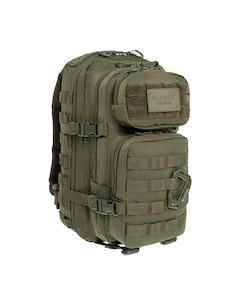
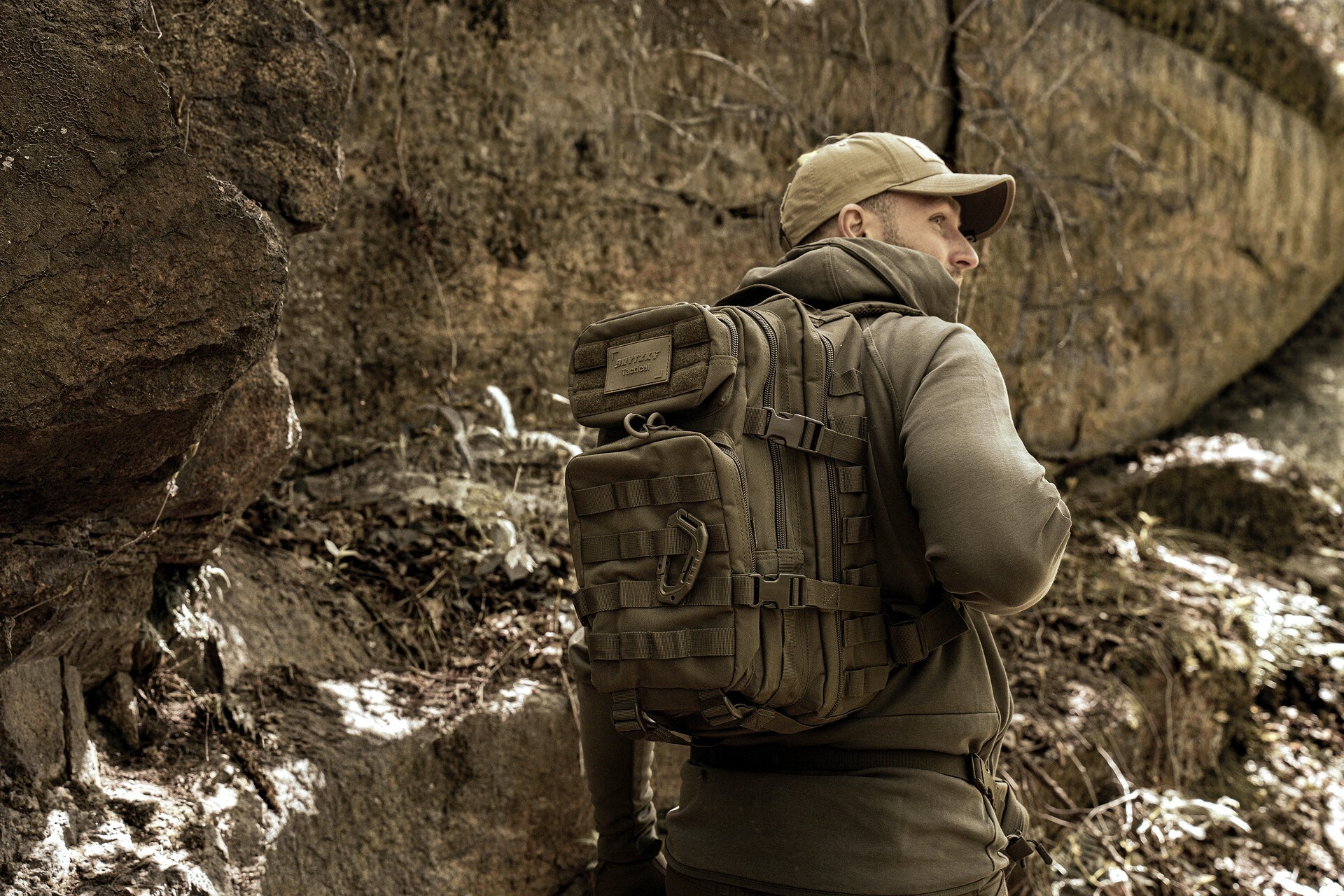
An excellent choice for initial training sessions could be the Brytzky Tactical Polygon Small 20 l. The backpack is made from Oxford 600D material resistant to abrasion, and the back panel is equipped with resilient foam to enhance carrying comfort. Adjustable straps and a hip belt help stabilize the backpack during walking, while side compression straps help minimize content movement.
The 20-liter capacity suits shorter training sessions where a large amount of equipment is not needed. The backpack also has a flat compartment at the back designed for a hydration bladder, and the MOLLE/PALS system allows for attaching additional accessories.
Is it worth rucking with a weighted vest?
A weighted vest is an interesting alternative to a backpack. The weight distributes more evenly around the torso, making it easier to maintain a stable posture and natural center of gravity. The vest also doesn't restrict arm movement, which can be useful when walking with poles.
However, it has its limitations. It may compress the chest, be less comfortable during longer training sessions, and offer less flexibility in weight changes. Good models are usually more expensive than backpacks as well. For beginners, a backpack will be a more versatile choice. A vest is primarily an additional option for more advanced individuals.
Rucking vs. trekking — where is the boundary?
Trekking is primarily about hiking and exploring terrain, mostly mountainous or wooded. Rucking, on the other hand, is a form of training where marching with specified weight and at a specific pace is crucial. It can be practiced almost anywhere, both in the city and in the mountains.
In practice, the boundary between these activities often blurs. Trekking with a heavy backpack can simultaneously be rucking training. The biggest difference is therefore about the purpose. Trekking is mainly about hiking, and rucking about training.
Common mistakes during rucking
Rucking is simple, but an incorrect approach can lead to overloads and injuries. The most common mistakes are:
- Too much weight – start with light weight and increase it gradually.
- Too fast progression – don't increase weight, distance, and pace all at once. Give the body time to adapt.
- Poorly chosen backpack – it should be stable, comfortable, and well-fitted to the back. Place weight close to the back.
- Incorrect posture – avoid hunching and leaning forward. Maintain a stable torso and natural body position.
- Lack of preparation – perform a short warm-up before walking, especially for legs, hips, and shoulders.
- Ignoring pain – fatigue is normal, but sharp or increasing pain is a signal to stop training.
Rucking backpacks in the Militaria.pl offer
Militaria.pl offers a wide selection of backpacks suitable for someone just starting out their journey with weighted walking as well as for an experienced rucker looking for equipment for tough, long sessions.
For a good start, we recommend military backpacks with a capacity of 20–35 liters with a MOLLE system and a sufficient carry system. Their durability—made from Cordura or ripstop nylon, metal fastenings, reinforced seams—ensures they will withstand years of regular rucking. Models with an ALICE panel or a vertical compartment for a ruck plate allow convenient and stable placement of weight close to the back, which is key to proper walking biomechanics.
If you prefer a more touristy style with enhanced carrying comfort, it's worth looking into the category of hiking and trekking backpacks. Many models have fully adjustable carry systems with a hip belt, which effectively manage heavier loads on longer walks. This is a good choice for individuals who want to combine rucking with hiking in the terrain.