Which sunglasses to choose?
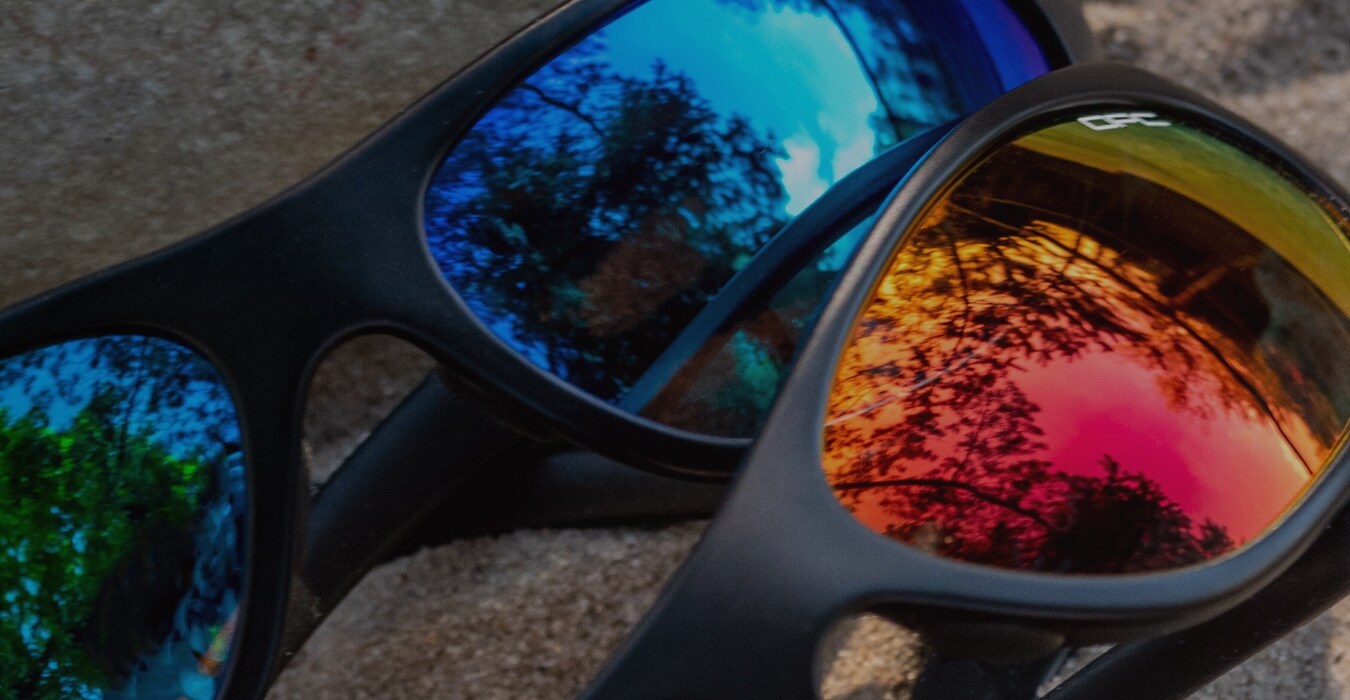
Choosing the right sunglasses can be a challenge due to the multitude of models available or the technology used. There is a wide range of models on the market, but how do you choose the right one? If you are planning to buy sunglasses, we encourage you to read our guide.
The most important function of sunglasses is to protect the eyes from harmful factors, mainly from ultraviolet radiation. In this article, you will learn what to look out for when choosing glasses. We will explain what the different parameters used in glasses are and what they mean.
Choosing sunglasses - what to look out for?
Sunglasses are widely available, for example in: optical shops, outdoor shops, sports shops, fairs or chain clothing shops. However, this does not mean that every pair of sunglasses purchased will be good. What's more, wearing glasses that only have tinted lenses can harm your eyesight. When you wear them, your pupils dilate through the darkening, but are not protected in any way from harmful ultraviolet radiation. This is why it is important to choose professional models that are fitted with the appropriate filters.
So what should you look out for? One of the most important selection factors should be the UV filter, which protects the eyes from ultraviolet radiation. Next, it is important to choose the right category and colour of lenses, as these parameters determine where the sunglasses in question will work. An important selection criterion is also the optical quality of the chosen model, which is responsible for the durability of the lenses and frames. To make wearing the glasses comfortable and convenient, it is advisable to try on several different pairs and choose the ones that will fit your face shape.
Markings on sunglasses - what are they?
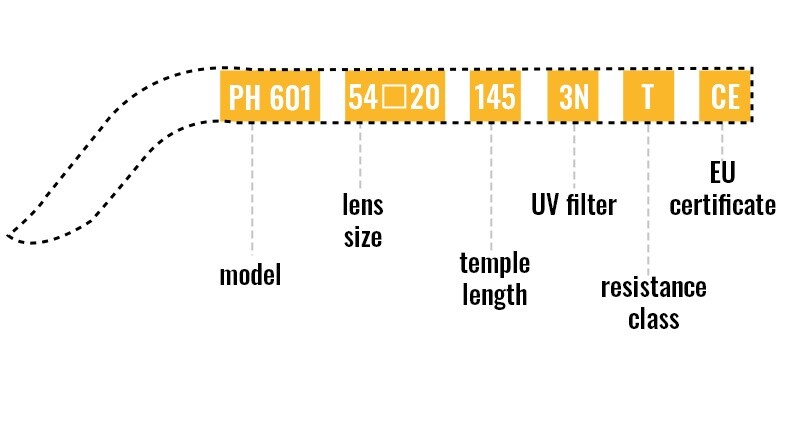
Before discussing the parameters, it is worth first looking at the markings you will find on sunglasses. The most common markings relate to:
| Symbol | WHAT DOES IT MEAN? |
|---|---|
| UV | (with a number e.g. 400 or a percentage e.g. 100%) indicates the ultraviolet filtration |
| CE | this indicates compliance with the European Protective Products Directive. In other words, the eyewear in question has been manufactured and tested to ensure adequate safety standards |
| POLAROID | eyewear with this mark has been fitted with a polarising filter |
| 0-4 | he filtration category, usually appears next to the UV designation |
| ANSI | comply with the requirements of the United States Standards Institute, relating to strength, protection and optical quality |
| SIZE | (e.g. 42x20x140) this designation refers to the frame size. For example, the size stated refers to the width of the lenses, the length of the bridge and the length of the temples, i.e. lenses 5.4 cm wide, bridge 2 cm wide and temples 14 cm wide |
On the frames of good sunglasses, you will sometimes also find markings such as 89/686/EEC, ISO 9001:2000, EN 166:2001 and EN 1836+A1:2009. They attest to the authenticity of the filters and the fulfilment of standards in Europe and worldwide.
Examples of markings on sunglasses
Filter sunglasses - which UV filter to choose?
The UV filter in eyeglass lenses is the most important parameter to pay attention to.
The sun emits ultraviolet radiation, the wavelength of which extends between 200 and 400 nanometres (nm). Failure to adequately protect the eyes, especially during prolonged exposure to the sun's rays, can lead to eyeball pain, tearing or burning. In extreme cases, conjunctivitis, keratitis, cataracts or macular degeneration can develop.
The filters in the lenses of sunglasses are indicated by the letters UV and the letter A, B or C. These symbols tell us the wavelength of ultraviolet radiation that the lenses block:
-
UVA - blocks wavelengths between 400 and 315 nm,
-
UVB – blocks wavelengths between 315 and 280 nm,
-
UVC – blocks wavelengths between 280 and 200 nm.
Which radiation is most harmful? In the band from 280 to 400 nm. Therefore, the most optimal filter will be a combination of UVA and UVB. You will find one of the following markings on sunglasses equipped with this UV filtration:
-
UVA+UVB,
-
UV 400,
-
UVA+UVB Protection.
Please note that such labels can also be found on glasses from unknown manufacturers, which are not necessarily true. It is worth bearing in mind that equipping glasses with UV filters is expensive. For this reason, cheap models of glasses from fast fashion manufacturers do not use filters. Always choose sunglasses from reliable manufacturers on which you will find, for example, the marking of European CE standards.
Sunglasses categories and lens tinting
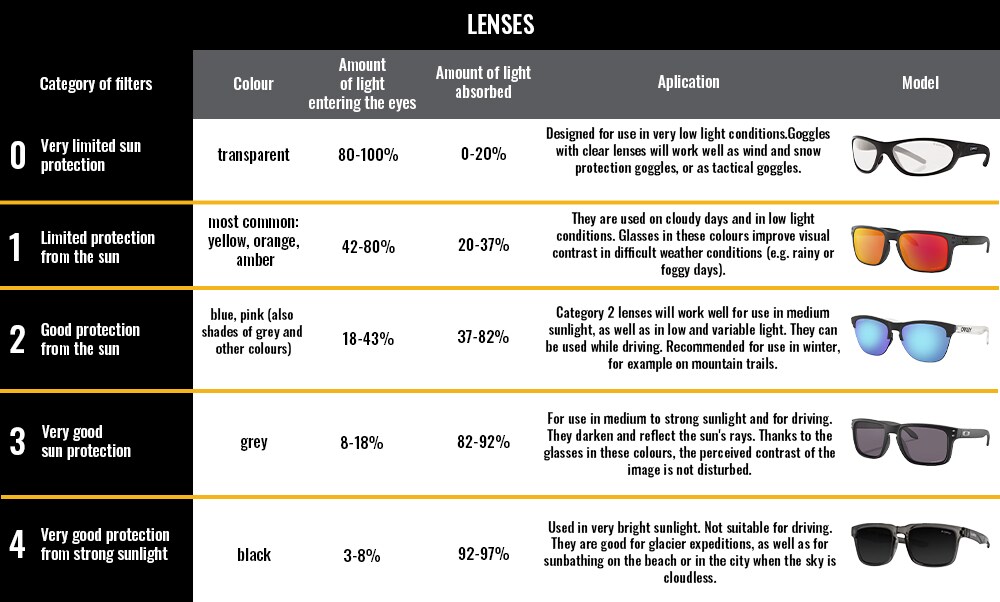
Other important factors are the filter category, the degree of lens tint and the lens colour. The degree of lens tint and lens colour is closely related to the filter category chosen:
Polarised sunglasses, or what kind of sunglasses?
Polarised glasses are nothing more than glasses fitted with an additional filter. A polarising filter is not essential, but it is certainly useful. What is its function?
Polarisation eliminates the oscillation of the light wave and sharpens the colours and contrast of the objects seen. In other words, the observed image is free of glare. Spectacles with a polarising filter are useful during winter mountain expeditions, when the light reflected off the snow tires and hurts the eyes. They are also useful for drivers and sportsmen.
Glass or plastic sunglasses?
It is a common belief that glass lenses are better than plastic lenses. Is this true? Not really. Using both mineral ones (colloquially known as glass) and organic ones (known as plastic) has its advantages and disadvantages.
Mineral lenses are associated with high scratch resistance. However, they are heavier and thicker, and fragments can damage the eyeball if broken. Glass-lens spectacles will be useful for people who work in dusty environments or with chemical reagents, or who are involved in welding or grinding. Organic lenses are much more commonly used in sunglasses.
Organic lenses (polycarbonate, Trivex or PNX) are lightweight and are ideal for sports and tactical eyewear. In addition, the Trivex (PNX) material is currently considered the safest material to use in eyeglass lenses.
We have outlined the advantages and disadvantages of using organic and mineral lenses below.
| organic lenses | mineral lenses | |
|---|---|---|
| advantages |
|
|
| disadvantages |
|
|
Tactical sunglasses
It is also worth mentioning about a specialised type of sunglasses, namely tactical sunglasses. Tactical glasses are protective eyewear that can be successfully used in areas where the eyes are particularly vulnerable to injury. Tactical glasses are most often used in military, police, firefighting or extreme sports. They will also work well in various outdoor activities.
The most important standards that tactical eyewear can meet are:
| ANSI Z78.1–2010 | MIL–PRF–31013 | EN 166 |
|---|---|---|
|
It defines the degree of protection in terms of hazards such as drops, splashes, impacts, radiation, dust or dust. Products that are tested under this standard are referred to as either impact resistant or impact protective. The latter must pass high-impact tests; if they meet these requirements, they will be labelled Z78+. |
It confirms the goggles' resistance to at least being hit by a .15 calibre bullet flying at 195 - 201 m/s. In addition to these ballistic parameters, the standard also specifies requirements for, among other things: optical clarity, UV protection, chemical resistance and environmental stability (i.e. resistance to varying temperatures and humidity levels). |
It refers to four levels of ballistic protection (S, F, B and A).
|
Sunglasses range at Militaria.pl
After reading this guide, you already know how to fit sunglasses to your needs. Take advantage of the extensive offer of the Militaria.pl shop and choose one of the hundreds of products available, which will certainly meet your expectations and ensure comfortable vision in all conditions. If you still have any doubts, use the help of our experts, who will expertly advise and help you choose the best sunglasses.