Camouflage in the field during Airsoft games
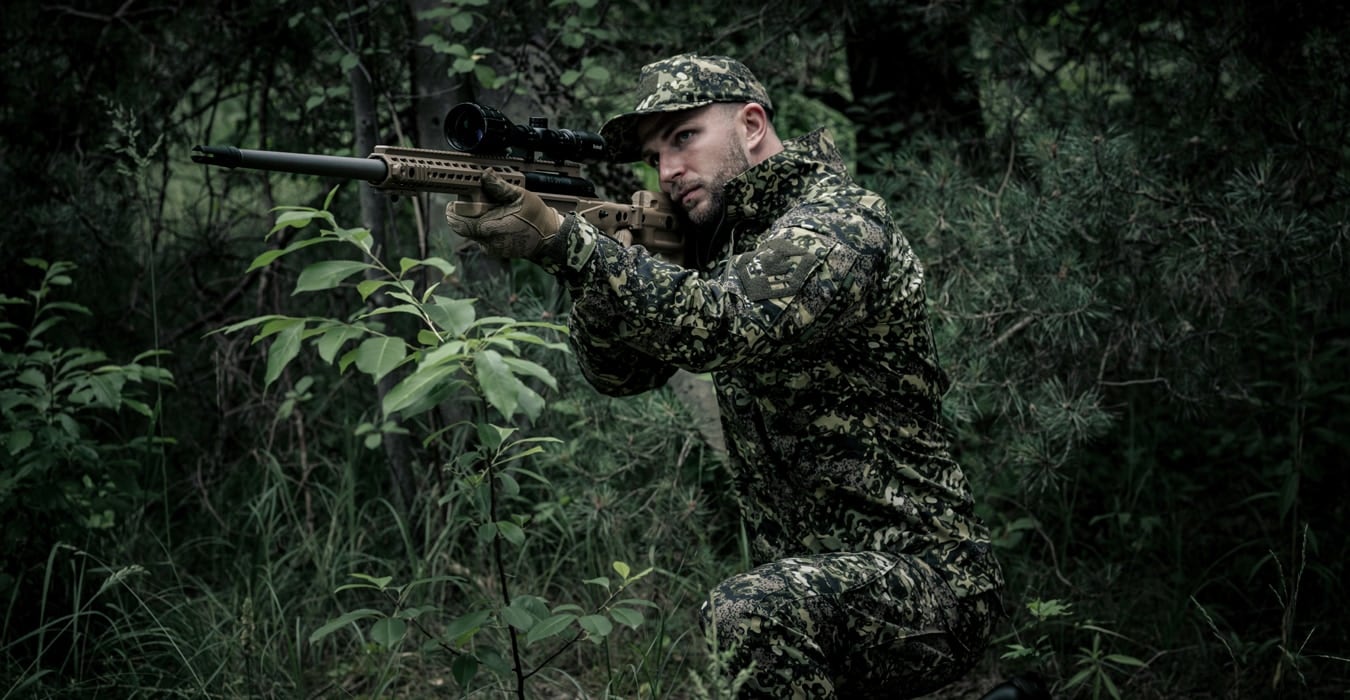
Remaining invisible to the enemy is a matter of life and death on the battlefield - literally. In this regard, it is not surprising to see the plethora of ideas and solutions, developed over the years, that can reduce the likelihood of detection. In the case of ASG games, the game is fortunately not played for such high stakes, but the excitement of the competition is also enormous and every opportunity to gain an advantage is important. Check out how to camouflage yourself during ASG games!
Briefly about types of camouflage
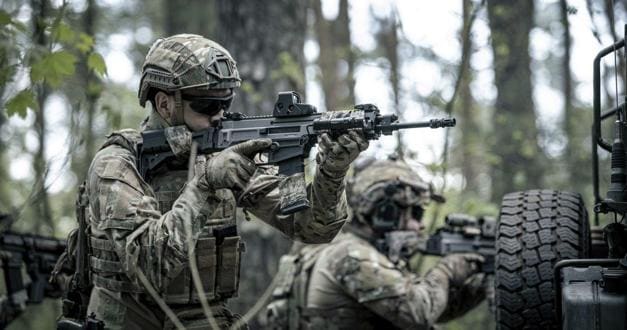
Camouflage is divided into two basic types: mimetic and deformation. In a nutshell, the first is responsible for making the color resemble its surroundings and blend into the background, and is based on small-sized spots, the so-called micro-pattern. The second, on the other hand, helps break up the characteristic shape of an object using large stains that form the so-called macro-pattern.
These features are intertwined in different proportions in every camouflage pattern available on the market. The most successful solutions, such as MAPA, combine both features within a single pattern. Learn more in our guide to camouflage theory and its development in recent years.
Masking in the field - what to pay attention to?
There are several key aspects to pay attention to when masking. By consciously approaching them and avoiding related errors, the risk of detection can be significantly reduced. However, when we are the observers, we pay attention to really small changes and irregularities in the environment.
Movement - a person picks up movement very easily even out of the corner of his eye, without focusing his eyes on a particular point. The chance to remain unnoticed is to move very slowly and smoothly, or to remain completely motionless if possible for tactical reasons. Care must also be taken to ensure that we do not cause additional movement in the environment by frightening birds or moving spring branches.
Shape - next to movement, one of the easiest aspects to pick up in the observed area are familiar shapes and contours in the form of, among other things, a human silhouette, a face or a weapon. This is the reason for the use of deformation camouflage or ghillie outfits. Three-dimensional additions like fragments of vegetation, nets, yarns, hats and scarves are useful in breaking familiar shapes.
Color and surface - a distinctive color will catch the eye of even an inexperienced observer. Here, mimetic camouflage is bowed, allowing it to blend into the background. It should match the environment and the season. In the context of the color scheme, it should not be forgotten that the camouflage must not only match the environment, but also be consistent within the frame of the armament. Wearing a black vest or sand colored knee pads on top of forest camo is a solution that opponents are sure to enjoy. A related issue is the surface - even the best-matched camouflage color scheme will fail if there is a perfectly flat and unnatural-looking object surrounded by objects with irregular texture.
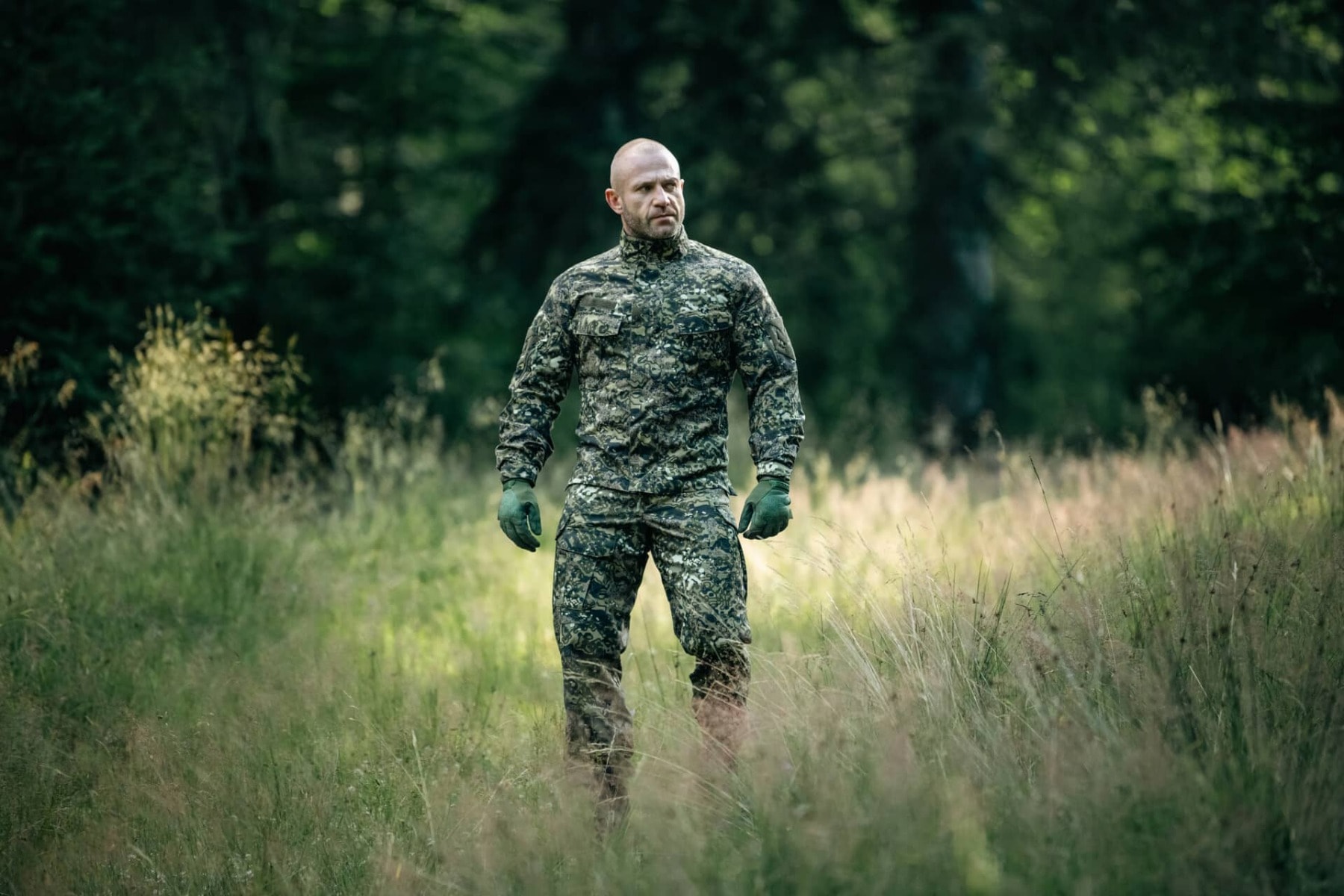
Repeatability/regularity - in nature, equal spacing between objects, perfectly vertical lines, perfect symmetry or geometric figures are unheard of. Therefore, regular patterns should not be used when painting weapons or faces and when preparing a hide.
Glare - in natural surroundings, intense glare occurs practically only on the water mirror. Therefore, try to avoid any high-gloss metal items or protect them accordingly. Use binoculars, spotting scopes and other optical devices that can reflect light and give away your position judiciously. The glass of a watch or metal bracelet, a knife head, an immortal, and a smartphone screen that will act as a mirror can also be highly visible. On the other hand, remember not to forgo protective eyewear under any circumstances during ASG games for this reason. No battlefield simulation is worth risking getting hit in the eye.
Sound - while camouflaged, we can be not only noticed, but also heard. Apart from the obvious situations when we deconflict with a conversation or a sneeze, beware of metallic sounds of equipment and rustling of clothing. Noise can also be caused by broken twigs and trampled leaves. In the case of ASG, it is undoubtedly worth giving up rattling Hi-Cap magazines in such a situation.
Silhouette - even the best camouflage won't help at all if you climb a hill and position yourself against a bright sky, stand against a body of water or at a greater distance from a forest wall, which, from an observer's perspective, will cause a markedly different refraction of the incident light.
Smell - another sense that can be used for detection. Forgo heavy-duty deodorants or aftershave. Likewise with insect repellents, it doesn't hurt to choose an unscented variant. Remember not to go to extremes and forgo antiperspirant - especially on hot days. Cigarette smoke is also a distinct odor, not only when smoked, but also remaining for a long time on clothing.
Shade - it can be both an ally in which to hide and an enemy that will reveal our position. Improper positioning casts a shadow that is discernible on the ground despite the fact that the silhouette itself does not stand out in the forest. The shadow causes the biggest problems in the morning and evening, when it can be several times longer than the object casting it.
Surroundings - you can refine to perfection both the camouflage of yourself and equipment, but traces of interference with the environment can betray our presence. Examples include scattered leaves used for camouflage. Therefore, it is advisable to obtain materials from nature at a certain distance from the subsequent camouflage position.
How to camouflage in the field. What is the most difficult to hide?
Camouflaging the face
Effective face concealment is very important in ASG camouflage, and this can be achieved in several ways. We'll start with painting - a method that is very effective, but requires some commitment. Dedicated paints are used for face painting, often offered in kits that allow us to create a composition that refers to the camouflage of our equipment, and at the same time to the environment in which we will camouflage ourselves.
When painting the face, the key task is to break a certain characteristic pattern that each of us learns practically from birth, recognizing the people around us. Painting, therefore, must not be symmetrical, must not emphasize the layout of the face with exposed eyes, lips or nose. The visibility of the best-lit parts of the face, such as the nose, eyebrow arches, cheekbones or chin, can be offset by using dark colors. Such a scheme allows to level out the characteristic features of the face picked up by the observer's brain, and further minimize three-dimensionality and better meld with the background. Do not omit the ears and neck (especially if you do not use a scarf or shawl). This is a fairly common mistake, yet the contrasting skin of other body parts can unmask us just as quickly as the face.
Another way to camouflage in the field is through dedicated clothing items. You can choose from chimneys, scarves, personal attachment nets, scarves, shawls or arafatas. There is no single, ideal solution here, and it is important to remember to select the equipment according to the situation.
The plus side of the chimney sweeps is that they effectively cover almost the entire face, including the ears and neck. The camouflage of a helmet using a net will not interfere with it. The downside of the balaclavas is revealed in the summer. On a hot day it can be just incredibly hot in them, making it much more difficult to operate effectively in the field.
Scarves and scarves are characterized by their versatility. In addition to the lower part of the face, they can also cover the ears and neck, and do not interfere with helmets or hats. In addition, they come in many camouflages, which allows them to easily match the rest of the equipment. In addition, they are quite breathable, which is important in the context of high temperatures or intense exertion during gameplay. The disadvantage is that they don't cover the entire face and for high effectiveness you have to combine them with painting anyway.
Personal camouflage nets can effectively change the observer's perception of even an entire silhouette. Deformation of known shapes is possible thanks to the option of easy attachment of all kinds of additions in the form of twigs and yarns. Shape collapse is also served by the loose hanging netting itself, which blurs the characteristic human silhouette. Scarves can also help conceal the lower part of the face and neck, and, in case of emergency, the arms.
In ASG games, protective masks are a great option. Not only do they protect well from damage, but camouflage versions provide better camouflage. They can also be easily combined with helmet camouflage and goggles.
ASG Weapon Masking
A distinctive shape, clearly standing out from the background, is the weapons. You can also use camouflage paints to camouflage them. It's best to use dedicated spray solutions, offering colors that allow you to match your camouflage with the rest of your equipment like green, black, gray or sand. Be sure to choose paints with a matte finish so they don't cause light reflections. In any case, it's worth taking care to prepare the surface by cleaning and degreasing the surface to allow the coating to become durable enough. A clever solution is washable paints, allowing the replica to be quickly restored to factory condition.
As with uniforms, small stains will be more effective for camouflage at close range, while larger stains will refract the shapes of the weapon, making it harder to spot at greater distances. When painting, paper stencils or leaves and twigs can be used to ensure realistic reproduction of shapes found in the environment.
Camouflage paint is, of course, not the only way to mask ASG weapons. Masking tapes are also an effective solution. The tapes are usually about 5 cm wide and several meters long. They are not covered with glue, but thanks to a special coating they adhere to each other, just like stretch film. A big advantage of the tapes is that they have a ready-made camouflage pattern applied to them, which can be matched to the rest of the equipment. Often, camouflage tape is also used to protect the rest of the tactical equipment due to its simple, non-invasive installation and the convenience of changing to a different pattern if necessary.
Attaching additional camouflage elements to the weapons is also an idea worth considering. Such a solution will enhance the deforming effect and obliterate the characteristic shape of the weapon used. These can be fragments of vegetation in the form of various types of twigs embedded on the camouflage netting. However, they require relatively frequent replacement. Another option is elements modeled on ghillie suits or sniper scarves. However, it is necessary to ensure that such accessories do not restrict access to targeting instruments and moving weapon parts.


Masking a military vehicle
To camouflage a military vehicle, matte paints can be used as an effective complement to the classic one-color paint job. The second solution is camouflage nets with vegetation or its plastic imitation. The objects we use must be large enough to refract the shape of the vehicle, which can easily be picked up by an observer. A military vehicle also often leaves visible traces in the environment.
In the case of vehicles, it is important to remember that we are dealing with many elements that can cause light reflections. Protecting windshields, headlights and chrome parts with fabric will help reduce the risk of detection. The wheels can also be conspicuous - it is worth camouflaging them as well.
At the same time, do not forget that camouflage should minimize the functionality of the vehicle. The protection of moving and other components necessary for driving must be easy to remove, in order to be able to move the vehicle on the road in an instant if necessary.
Reducing the visibility of shoes
Boots can also be a problem when it comes to camouflage, due to the fact that they most often come in black, which, while it does not stand out extremely in most environments, definitely does not offer effective camouflage. The solutions, as in any situation, are several.
An effective and simple solution is to wrap the boots with scraps of material in a camouflage pattern that matches the uniform. Such a solution can even be extended to completely wrapping the boots, including the soles, which results in additional smearing of the traces left behind and protects even when lying down, when an observer behind you could easily pick up the distinctive black shapes. However, completely wrapping the shoes is also combined with problems. The material can easily become damp and does not provide as good a grip as the sole. Mesh should also not be used in this role, as it will simply hook on everything.
A simple way to reduce the visibility of shoes is to pull the legs outward and cover the uppers. The counterpart to this solution without compromising the pants and making it easier for insects to get in is to use stuptuts in a suitable camouflage.
Like much of the rest of the equipment, boots can also be painted. Special paints are used for this, allowing the boots to effectively match the camouflage used. The downside is the difficulty of getting the shoes into factory condition.
More and more tactical footwear in a color other than black is also appearing on the market. Olive or sand variants are already quite an improvement, while it is the boots in full camouflage, covering even the sole, that allow you to almost forget about the problem.
Where to source camouflage accessories?
We hope that the above guide was useful to you and you will apply at least some of the advice in practice. When you decide what you need during ASG games for effective camouflage, we invite you to take a look at the offer of our Militaria.pl store. You'll find most of the aforementioned accessories for improving camouflage, as well as sets of uniforms in various designs.