Which telescope for beginners to choose?
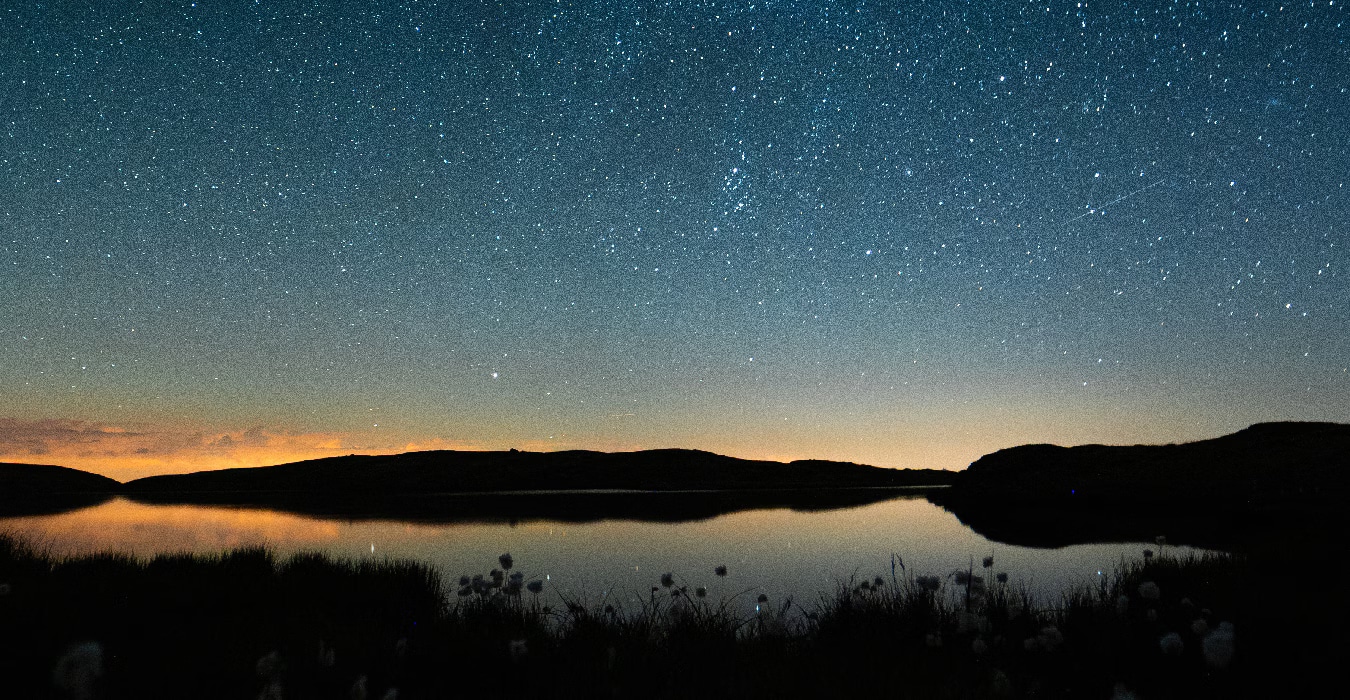
For beginner astronomers, choosing the right telescope can be a challenge. This is not made any easier by the sheer number of models on offer, which can be dizzying. The key to choosing the right equipment is to understand how a telescope works and to understand the features that affect its performance.
In this article, you will find information on the types of telescopes, as well as which parameters to look out for when choosing a beginner's model. This article will help walk you through the key aspects so that you can make an informed choice of a telescope that meets your needs.
What is a telescope and how does it work?
A telescope is an optical instrument that consists of two basic components responsible for its operation, and these are (depending on the model): lens and eyepiece (in a lenticular telescope) or eyepiece and mirror (in a mirror telescope). The two elements are connected by a so-called tube.

What is a telescope used for? This instrument makes it possible to observe very distant objects. Observation is made possible by the telescope capturing scattered light and focusing it into the focal point. Of course, this is a very simplified diagram of how a telescope works, as the exact way it works depends on the model of the instrument. You will read about how individual telescopes work later in this article.
Types of telescopes
The most popular for personal use today are lenticular and mirror telescopes.
When considering the purchase of a telescope, you may wonder which one to choose. The answer is not clear-cut, as both types of telescope have different uses and each will work well for observing different objects.
Lens telescope
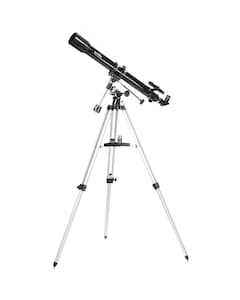
A lens telescope, also known as a refractor, is an instrument similar to a telescope (although much larger in size). This type of telescope uses a lens system that collects light and redirects it to the human eye. The lenses act as focusing elements, and through them the image is magnified and illuminated.
The lens telescope will work very well as a beginner's telescope. Its biggest advantage for those starting out in astronomy is its simplicity of use - it does not require complicated settings or calibration. Chromatic aberration can occur in lens telescopes. This is a defect that distorts the visible image, but can be prevented by using additional lenses.
What objects can you observe with a lens telescope? You can use it to observe celestial bodies close to the Earth or those of large size without any problems. You will get a detailed look at the Silver Globe with its craters, mountains and valleys. You will equally observe the planets of the Solar System such as: the near Mars and Venus and the more distant ones: Jupiter, Saturn or Uranus. The possibility of observing Saturn's rings, among others, is also worth mentioning. The lens telescope also allows more advanced observations that require good knowledge of the objects' trajectories and quick reactions. For example, you can try to observe the Earth's artificial satellites such as the ISS (it is worth checking the route of the ISS and observing its passage against the background of the Moon's disk). At this point, we would like to add that a lens telescope will work well for observing in cities, as it is not as sensitive to light pollution.
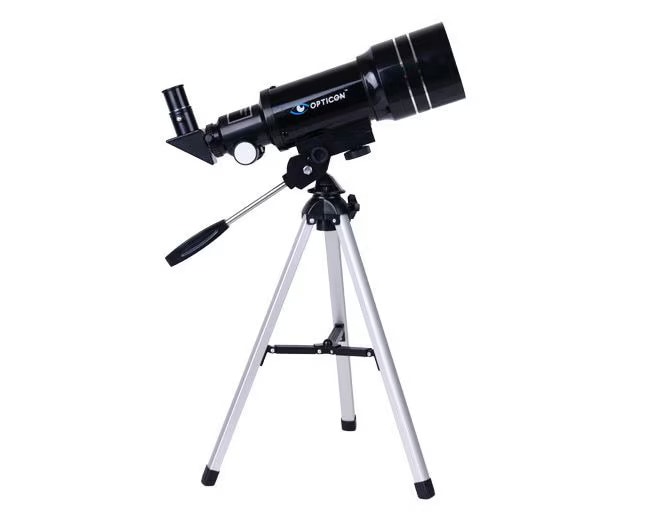
An example of a lens telescope is the Opticon Apollo 150x70 mm model. This is a model that will be great for beginner astronomers. The telescope has a maximum magnification of 150 x. This will allow you to easily carry out observations of the Moon and its craters, Mars, Venus, Jupiter and its moons and stellar constellations.
Mirror telescope
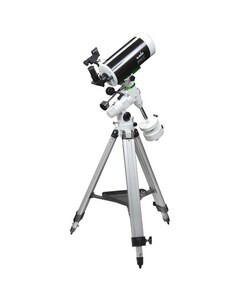
Another telescope we recommend is the reflector model, also known as a reflector. This type of telescope works on mirrors and uses the phenomenon of light reflection. The main structure of a reflector includes a main mirror and an eyepiece. In addition, these telescopes are equipped with a smaller secondary mirror, which leads the light beam out of the tube. The construction of a mirror telescope depends on its type. Newtonian and Cassegrain mirror telescopes are the most commonly used.
mirror telescopes are more complicated to use than lens models, and for this reason they are not a popular choice for a first telescope. However, this does not mean that you cannot start your night sky observing adventure with one.
When is a mirror telescope a better choice? If you are more interested in distant or rather dark space objects than the Moon or Venus, then go for a mirror telescope. This model will work well for observing nebulae, comets, asteroids, meteors and other deep sky objects.
However, it is worth bearing in mind that this type of telescope performs much worse in urban areas with light pollution. It is therefore advisable to go out of town to observe with a mirror telescope.
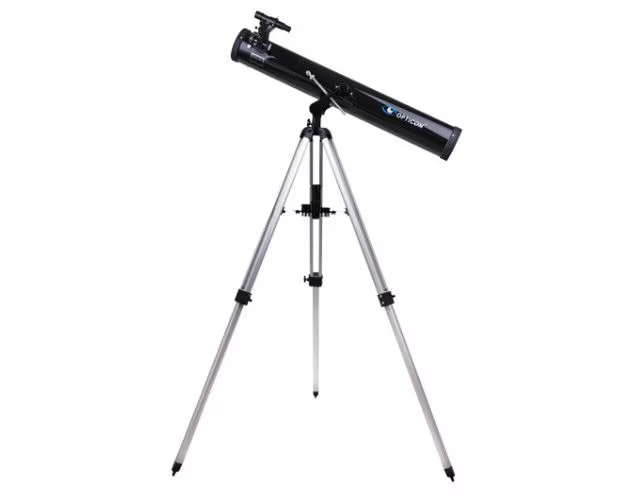
An example of a mirror telescope for beginners is the Opticon Horizon EX 350x76 mm telescope. It features a 76 mm diameter mirror, which provides a magnification capability of up to 350 x. The telescope comes with an additional spotting scope for observing fast-moving objects and a Barlow lens. Among other things, the telescope allows detailed observation of the Moon.
The telescope is equipped with an EQ1 parallactic mount, allowing the telescope to be positioned according to an atlas or sky map. The parallactic mount also ensures smooth movement (rotation) of the telescope. It will be very suitable for observations of the deep sky, including: stars, clusters, nebulae, the Moon and planets of the Solar System.
Comparison of lens telescope and mirror telescope
| Features | Lens telescope (refractor) |
Mirror telescope (reflector) |
|---|---|---|
| Optical construction | uses lenses to collect and focus light | uses mirrors to collect and focus light |
| Image quality | no central aperture — higher contrast and image sharpness | possible presence of central aperture — reduced contrast and sharpness image |
| Optical aberrations | chromatic aberration (light splitting), especially in cheaper models models | no chromatic aberration, but spherical aberration may occur (reduced visual acuity) |
| Size and weight | usually longer and heavier | usually shorter and lighter |
| Maintenance | sealed design to protect against dust and moisture — does not require frequent maintenance frequent maintenance | requires regular maintenance and cleaning of the mirrors |
| Price | usually more expensive | usually cheaper |
| Application | observation of the planets, moon and bright objects | observation of deep sky objects, e.g. galaxies and nebulae |
| Ease of use | simple settings, good for beginners | need for collimation |
| Weather resistance | less sensitive to temperature and humidity changes | more sensitive to temperature and humidity changes |
A telescope for an amateur — which parameters to look out for?
In addition to choosing the type and type of telescope, it is also worth paying attention to the parameters and technical specifications of each model. The heart of every telescope is its optical system. It is the elements and parameters of this system that will determine how sharp and bright the image seen by the observer will be.
A good telescope for a beginner should be matched to the observer in terms of weight, among other things. The weight of the telescope will have an impact if you choose to observe out of town.
Below you will find some information on the parameters to look out for in order to choose the best telescope model for a beginner.
Zoom
Intuition tells us that the higher the zoom, the better the observed object will be visible. However, this is not true, and what is more, too much zoom can significantly reduce visibility and thus the observation of the object. The optimum zoom value will be twice the diameter of the lens in millimetres.
Lens or mirror diameter
The diameter is the most important parameter, as it determines how much light the telescope can absorb, and thus how bright and high-contrast the observed image will be.Lenses and mirrors with diameters of up to about 200 mm will work well for observing close and large objects, while for observing distant and small objects it is worth looking for instruments with diameters of more than 200 mm.
It is also worth paying attention to the focal length. For observing larger deep sky objects, such as extensive nebulae and large star clusters, it is worth choosing short focal lengths (up to 1000 mm). Long focal lengths (above 1,000 mm) will work well for observing the Moon, planets, galaxies and globular clusters.

Focal length of eyepiece and focuser diameter
For observing objects such as stars, planetary nebulae, planets and globular clusters, it is advisable to choose telescopes with a smaller focal length, which offers a wider field of view. Telescopes with focal lengths from f x 0.6 to f x 1.5 are suitable for these purposes. On the other hand, for observing smaller and more distant objects, such as small galaxies and nebulae, telescopes with longer focal lengths, from f x 2 to f x 4, which offer greater zoom and better detail, are better suited.
The focal length is the diameter of the tube to which the eyepiece is mounted. This parameter is important if you intend to change eyepieces and filters in the future. A 1.25‘’ focuser is the most commonly used, which is why you will find many accessories on the market with this size.
Luminosity
The luminosity is a parameter that determines the brightness of a telescope. In other words, the value of the luminosity determines which objects will be seen well in a particular telescope.
If you want to observe close objects, such as the Moon and the planets of the Solar System, a telescope with an aperture value of less than 10 will be sufficient, while for observing distant objects it is advisable to choose models with an aperture value greater than 10.
Caution: For observing the Sun, choose a telescope with as low an aperture value as possible and buy special filters. Unskilled observing of the Sun can be hazardous to your eyes.
Telescope mount
The telescope mount is also worth adapting to the objects to be observed. If you want to observe the Moon, for example, an azimuth mount will work well. On the other hand, if you want to observe distant objects, where the minimal movement of the telescope is of great importance, it is worth opting for a more precise parallactic mount (included with most telescope models in the Militaria.pl offer).


Which telescope to start with? — summary
When choosing an astronomical telescope for beginners, it will be a good idea to determine what objects you want to observe - the Moon, the planets of the Solar System or distant galaxies? You already know how to select a telescope for the object to be observed. It is also worth looking at additional accessories, such as interchangeable eyepieces with different focal lengths, with which you can modify the characteristics of your telescope. Are you still wondering which telescope to choose? You can find various telescope models in the offer of Militaria.pl, and if you have any doubts, please contact our experts!