The sword is nice, the handle is wrapped quite well and is of good length to hold comfortably. It is pleasant to work with. The cutting part is quite sharp - it cuts through a hanging sheet of paper without effort, cuts leather, and slices cardboard. In tests on branches, it easily cuts branches up to about 3 cm thick. Thickness from 5 cm is, at least in my hands, impossible to overcome. It is quite easily straightened with a hammer if bent. The steel is rather soft, so after some fun in the forest it became chipped, got loose in the handle, and after straightening with a hammer it looks like a real sword after a hundred and ten battles :D Please don't moralize if someone treats this type of weapon as a fetish. In medieval Japan, they also tested the durability of swords - only on the corpses of convicts (the point is that very experienced professionals did it, but before becoming such, many blades were ruined).
Boker Magnum Akito Sword
A katana inspired by traditional Japanese patterns, made of high-quality materials such as carbon steel and lacquered wood. The combination of classic form and solid workmanship makes it suitable as a collection piece as well as a practice tool.
Carbon steel blade with visible hardening line
The blade, 72.5 cm in length, is made of clay-hardened 1045 carbon steel, with a visible hardening line (hamon), emphasizing its traditional character. The full tang design, where the blade goes through the entire length of the handle, has been reinforced with two studs (mekugi) for stability and durability. The blade's thickness of 7.6 mm guarantees adequate strength and reliability during use.
Wooden handle and metal tsuba
The wooden handle has been laced with traditional cotton thread, allowing for a secure and comfortable grip. The metal tsuba with Japanese-inspired motifs stands out for its careful craftsmanship.
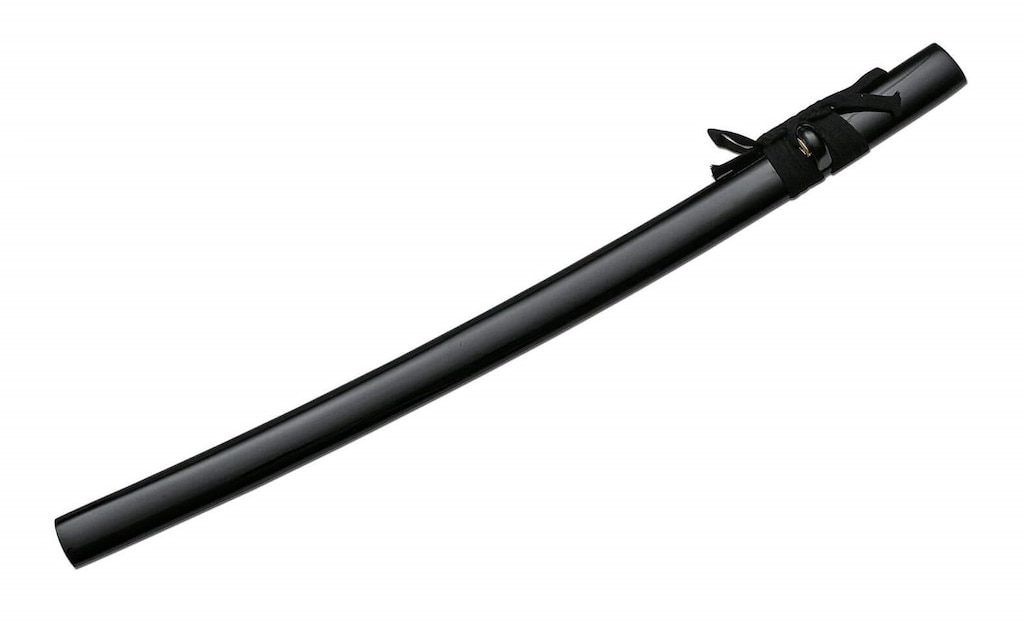
Lacquered black scabbard
The saya, or scabbard, is made of black lacquered wood and enhanced with traditional elements such as kurigata and shito-dome, which highlight the attention to detail.
Purpose
The sword is suitable for various forms of training, such as kata, iaito, or cutting tests (tameshigiri). It makes a practical tool for those training in martial arts, as well as an interesting item for collectors.
Main features
- 1045 carbon steel clay-hardened blade with visible hamon
- full tang construction reinforced with two pins (mekugi)
- blade length 72.5 cm, thickness 7.6 mm
- wooden handle braided with traditional cotton thread
- metal tsuba with motifs inspired by Japanese culture
- black lacquered scabbard (saya) with kurigata and shito-dome elements
- designed for martial arts training and cutting tests (tameshigiri)
Technical data
Blade length: 725 mm
Blade thickness: 7.6 mm
Steel: carbon
Handle: wood
Scabbard: wood
Overall length: 102 cm
Weight: 1120 g
Manufacturer: Boker, Germany
Militaria.pl is a premium dealer of Boker.
Boker is a German knife brand with a tradition dating back to the 17th century, known for its distinctive chestnut tree logo - "Tree Brand." As early as 1830, the company was producing as many as 2,000 sabers per week, which reached European battlefields. In the 19th century, it expanded its operations to the USA, Canada, and Mexico, creating recognizable branches. Today, the main factory in Solingen specializes in handmade collector's and utility knives, also using steel recovered from historical objects, such as the battleship Tirpitz. The brand offers four lines: Boker Manufaktur Solingen, Boker Plus, Magnum, and Arbolito. Boker products are valued by collectors, uniformed services, and chefs around the world.
| Overall length | 102 cm |
|---|---|
| Blade length | 725 mm |
| Blade material | Carbon |
| Weight | 1120 g |
| Melee weapon type | Japanese sword |
| Cutting edge | Sharp |
| Blade thickness | 7,6 mm |
| Handle | Wood |
| Sheath in the set | Yes |
| EAN | 4045011101212 |
| Manufacturer code | 05ZS9126 |
| Brand | Boker |
| EAN |