Lumens, LEDs and batteries - what you need to know about flashlights
How many lumens should a good flashlight have? What is the point of LEDs? Better battery-powered or rechargeable? These are questions that many people who want to buy a new flashlight ask themselves. No wonder, since there are many models on the market with different specifications, and it's not hard to get lost in it all. In this guide you will learn what to look for when buying a flashlight, how many lumens you will need and what about those LEDs. You'll also learn about the basic differences in power supply types and how a handheld flashlight differs from a headlamp.
What are lumens?
Lumens indicate how much light is emitted by a light source (in this case, a flashlight). Therefore, it can be deduced that the higher the value of lm (lumens), the more light will be emitted. The question immediately arises: how many lumens does a powerful flashlight have? The answer to this question is not clear-cut, and it is difficult to determine how many lumens a flashlight should have to meet the user's requirements. For general use, it can be assumed that 1000 lumens should be sufficient for most applications for the average user.
However, it is worth noting that a powerful flashlight is not only the number of lumens. Many factors influence how the flashlight will shine: the type of LED used, the number of LEDs, the design of the flashlight, the quality of the reflector and lens. Of course, you don't have to be an expert in electronic circuits, optics and lighting to buy a good flashlight. You just need to be aware of what you actually need and what a particular piece of equipment has to offer.
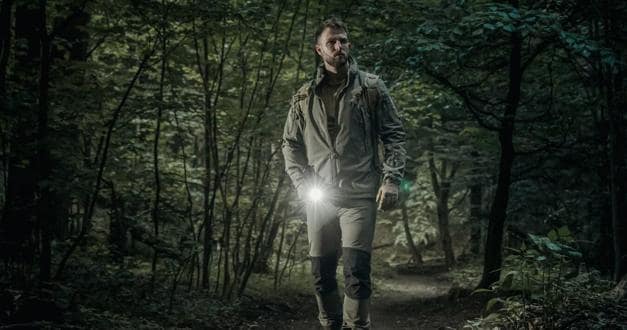
Lumens give you a general idea of how strong the flashlight will shine, but they won't tell you whether the flashlight will shine with focused light over a long distance or diffused light, but at closer distances. The truth is that 200-300 lumens in a well-built flashlight with a good quality reflector will be sufficient to illuminate the area around the property and the area around us while walking. However, if you need to shine a stronger light from time to time, to see what is a few hundred meters away, then you will need more than 1500 lumens.
If you're looking for a powerful flashlight and want to be an informed customer, then don't stop at just lumens, get further acquainted with the LEDs used by flashlight manufacturers.
LEDs in modern flashlights
LED technology is used today by all flashlight manufacturers around the world. Why? Because LEDs are superior in every way to standard incandescent bulbs - definitely more efficient, less power consumption and ultimately cheaper. It is also worth mentioning that they are resistant to shock and vibration, at which the filament of incandescent bulbs can be mechanically damaged.
The best led flashlights are equipped with top-class LEDs. They can differ, for example, in the color of light. It is usually referred to as cold or neutral. Cold is simply brighter, more like a blue color. Warm color is hardly ever used in flashlights. Hue is given in Kelvins, and the higher this value, the brighter the light. Neutral is 4000-5000K, and cold color is above 6000 Kelvin (the characteristic blue tint of led lighting). To better illustrate this, take a peek at the attached image.
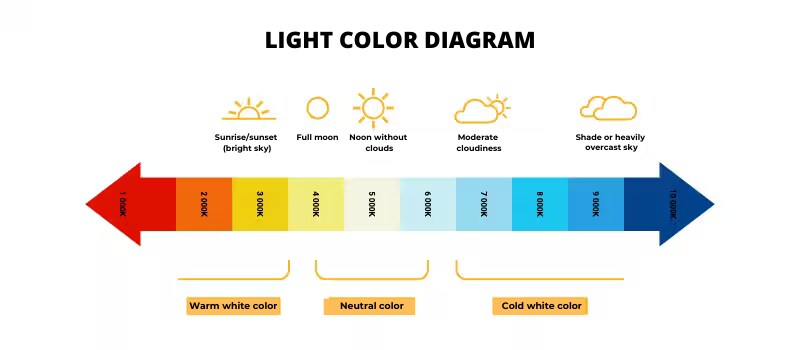
It is important for you to know exactly what you are looking for. The best led flashlight is the one that will meet your expectations. The most important thing would be for you to determine in what conditions you will use the equipment and how often, as well as what range of area you will illuminate. Colder colors will be better for universal use. Neutral or warm will work better, for example, for illuminating a tent or a cabin in the woods - it is more comfortable to relax with such light. Also remember to decide on proven manufacturers.
Batteries and accumulators
You may hear from many people that there is nothing like a good rechargeable flashlight. Of course, there is a lot of truth in this, but we will try to give you an idea of the pros and cons of different solutions when it comes to power.
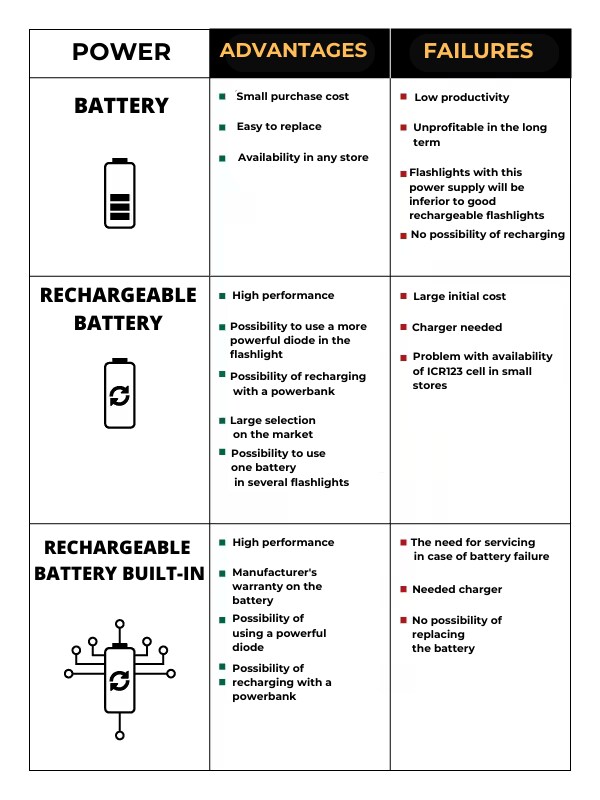
To begin with, let's consider ordinary batteries. They will be the power source in most basic flashlight models, which are equipped with low-demand LEDs. The battery has the advantage of being cheap, readily available and very easy to replace with another one. What is the disadvantage of batteries? First of all, the capacity - the flashlight will not shine for a long time on the battery. Another issue is that for longer expeditions you need to have a supply of several, so as not to run out of light source. Another important issue is that despite the low unit price of batteries, in the long run you will find that you will spend more on all batteries than on one solid battery at the same time.
Another source of power is accumulators. And here manufacturers really have a lot of room to maneuver. By using rechargeable lithium-ion batteries to power flashlights, there is a chance to mount a much more powerful diode, which needs high voltage and a lot of current in order to give its best. Top-of-the-line LEDs have no chance to work properly on ordinary AA or AAA batteries. The exception is CR123 batteries, which have long supplanted ordinary sticks.
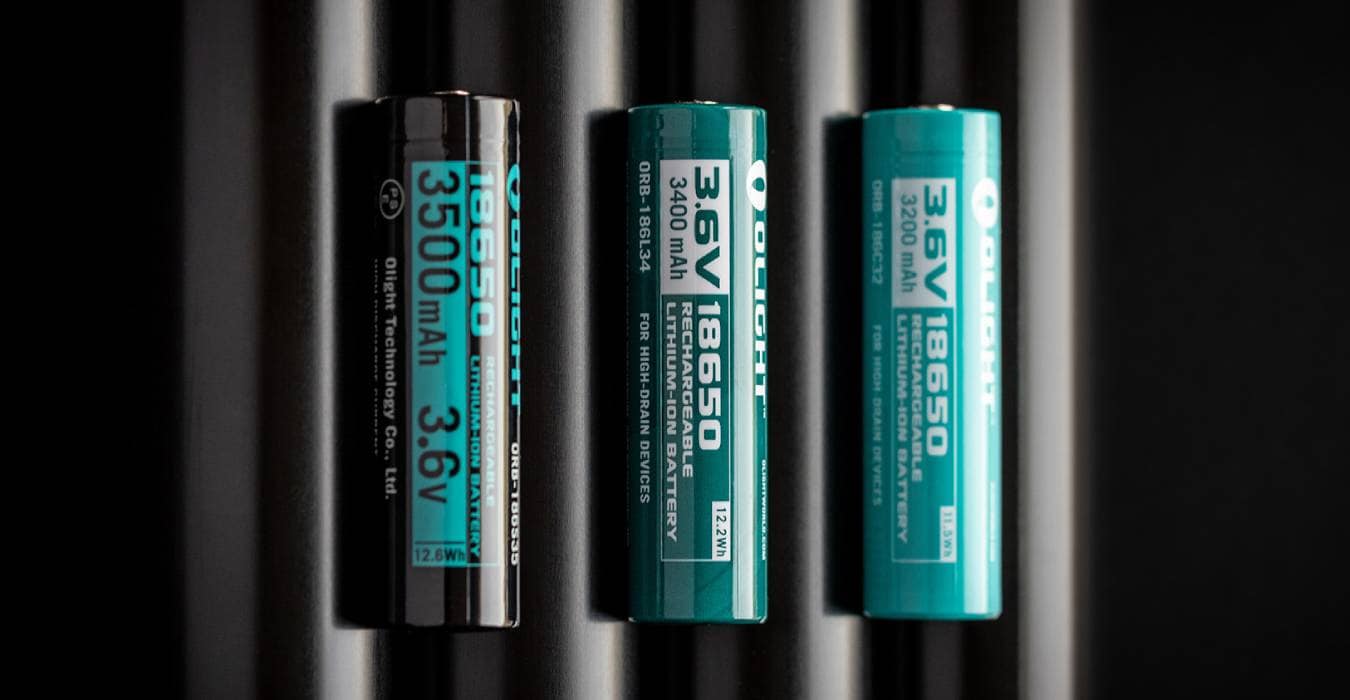
The batteries have a voltage of 3.6 or 3.7 volts. The big advantage of rechargeable batteries is their different capacities, which will allow the flashlight to shine shorter or longer. The most popular battery used to power flashlights is the 18650 cell - it is also the most efficient cell. Its standard capacity is 3400 mAh. There are also other cells: ICR123, 14500, 26650.
ICR123 is the smallest cell used in small flashlights. Despite its small size, flashlights equipped with such a battery still shine much stronger than any battery-powered flashlights. Despite its many advantages, such a power supply has disadvantages as well, of course. These are, first of all, the higher initial cost and the fact that you need to have a charger in addition. Fortunately, many manufacturers throw in chargers in the package with the flashlight. If you'll need more than one battery, get ready to spend more, but don't worry - frequent use of a good rechargeable flashlight will pay for itself very quickly.
The last (and least common) type of power supply is the built-in rechargeable battery. The manufacturer installs a single, integrated battery, which you will be able to charge without removing it from the flashlight. Such a battery also has a higher capacity than a standard one. Thanks to this solution, the equipment will work more stably and efficiently, as the battery has been tuned to the pre-programmed modes. The manufacturer gives a ready-made, well-functioning solution, which makes the use of the flashlight with such a power supply less troublesome.
To illustrate all the advantages and disadvantages, take a look at the infographic below about power supply types:
Handheld and head flashlights
Flashlights are divided into two main types: hand-held and head flashlights. Handheld flashlights are the most popular and, as the name suggests, are used to operate with the hands. Head flashlights are used to attach to the head with a strap. Which type to choose? When to opt for a handheld flashlight, and when to bet on a good headlamp?
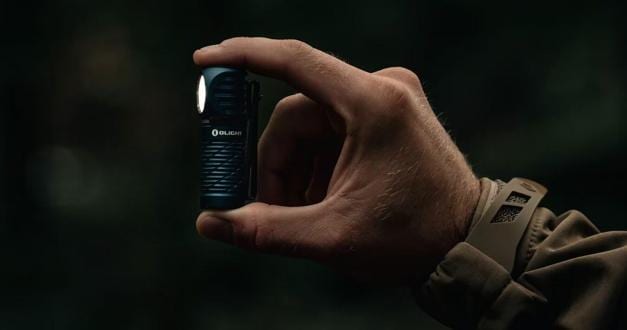
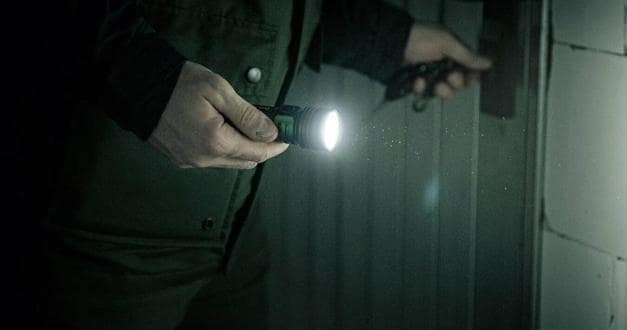
Handheld flashlights are usually the flashlight itself plus a rechargeable battery or battery. In such flashlights, you usually have a choice of a long range and strong light focus, or a shorter range but a greater angle of illumination. There are small, medium and large flashlights, as well as giants that you have to hold with both hands. But the most popular are medium-sized flashlights, powered by a single 18650 cell with several light modes and bright light color. Such a flashlight is a good all-purpose piece of equipment that will serve in most life situations. They have one disadvantage - you have to hold them.
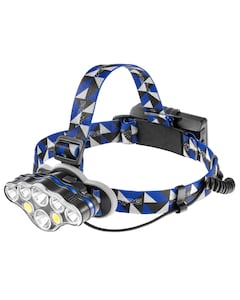
What if you need to keep your hands free, but still need a light source? Headlamp flashlights come to the rescue. They are mainly used for work and sports. They are usually small, lightweight flashlights on a strap that you put on your head. Manufacturers use a special adjustment so that you can set the angle of the flashlight to the place you want to illuminate. Here, too, there are battery and rechargeable flashlights. A head flashlight is meant to light your way when you're biking (see guide to bicycle flashlights), hiking or doing manual work, such as when your car breaks down at night in the wilderness and you need to rummage under the hood. Headlamp flashlights emit diffused light, but you are still left with a choice of several light modes.
There are still headlamps that can also be used as handheld flashlights. This has been brilliantly solved by Olight. If you decide to buy an H-series flashlight, you get a flashlight, a battery, a charger and a strap for mounting the flashlight and attaching it to your head. The flashlight is very similar in design to the classic flashlight, but the LED with protective glass is directed perpendicular to the body of the flashlight so that the user can decide how he currently needs to use the light. You can hold the flashlight in your hand, and when necessary - attach it to a strap and put it on your head. You still have the option in this case to change the angle of the light. This is a great solution for people who are looking for a universal flashlight and do not want to carry two flashlights. If you want to learn more, take a peek at our guide to head flashlights.