Types of steel in knives and their properties
When buying a knife, it is worth paying attention to this element as well - if you are buying a knife that is going to be useful and serve you for many years - it is worth taking a moment to find out some basic information about the materials used to make knives.
We advise you to come back to this article once you have chosen the knife you want to buy - it is a good idea to check out some information about the material of the knife before you make your purchase.
The basic material from which modern knives are made is steel, which is an alloy of iron with carbon and (usually) other elements (alloying elements). Other metals such as titanium or cobalt alloys are used much less frequently, as are non-metallic materials such as sintered ceramics or plastics and glass or carbon fibre reinforced laminates.
Selection of materials in knives
The choice of materials and their processing is crucial to the durability of both the entire blade and the cutting edge (blade) itself. The higher the quality of the materials, the longer the knife stays sharp and in one piece. However, this is a complex issue that is made up of several factors. The most important of these are:
-
strength (the ability of a material to resist deformation loads),
-
abrasion resistance (resistance of the material to the formation of cavities due to friction),
-
impact resistance (resistance of the material to cracks and fractures caused by dynamic loads such as impacts or sudden application of a lever),
-
elasticity (the ability of a material to return to its original shape after the forces causing deformation have ceased).
The complex of the properties mentioned constitutes the characteristics of the various steels, but it is only the appropriate heat treatment (hardening, tempering, freezing) that brings them out and balances them. In general, the purpose of heat treatment is to give the steel an appropriate hardness, which in the case of knives usually ranges from 53 to over 63HRC (Rockwell hardness). However, here too the problem is complex. As hardness increases, wear resistance and strength increase, but impact strength decreases at the same time. However, this relationship is not true for the entire graph of hardness increment - a specific exception is the so-called impact peak, where at relatively high hardness we have significantly higher impact strength than a couple of HRC less or a couple of HRC more. The ability to hit this point during heat treatment and the repeatability of this process in production are essential to produce a top-class blade. As hardness increases, elasticity also increases only up to a certain level, beyond which the steel becomes increasingly brittle and cracks instead of returning to its original shape.
The same is true for strength, and once a certain hardness limit is exceeded, the steel no longer resists higher loads, but crumbles. This makes it necessary to determine the optimum hardness range within which a particular steel grade can be hardened, and the optimum hardness for the intended application of the knife model in question. In the case of knives, the theoretically best steel is one that can be hardened to a high hardness (59 - 63 HRC) while retaining good impact strength. If to this we add a friction-resistant structure (rich in hard carbides), we are close to achieving the ideal. Unfortunately, such steel, especially its machining and heat treatment, is very expensive and not always necessary. The heads of large knives intended for chopping do not need to be particularly abrasion-resistant, and we do not expect great impact strength or resilience from compact folding knives. Sometimes, therefore, it is worth sacrificing one of these properties in favour of emphasising another, which can be achieved by special hardening or simply by choosing a particular type of steel. Strength, on the other hand, is almost always a highly desirable parameter, as it provides adequate stiffness and prevents permanent deformation of the cutting edge, the tip and, in the case of heavier loads, the entire blade.
A separate issue is the stainless properties, which depend almost 100% on the chemical composition of the material. In the case of steel, the element most responsible for stainless is chromium - the more chromium there is, the more resistant the steel is to corrosion; unfortunately, at the same time, an increase in chromium content results in a decrease in impact strength. For this reason, for machetes and larger knives intended for chopping, "rust" steel (spring or tool steel) containing only a small admixture of chromium or no chromium at all is preferable.
We hope that the following overview of the materials used for knife blades will give you an idea of the subject and make your choice easier. Please note, however, that the performance of a blade does not only depend on the grade of steel or other material and its declared hardness. The properties of the blade of two knives made of the same grade of steel, hardened to the same hardness, but coming from two different manufacturers can differ, sometimes quite considerably. Much depends on the steelworks where the material was purchased, the degree of heat treatment and quality control. It is therefore advisable to be guided by the reputation of the manufacturer, as well as the opinions of experienced users. A separate issue is the correct sharpening of knives (sharpening angle, symmetry and finishing of the cutting edge), since mistakes made here by manufacturers and users themselves can negate the advantages of even the best steel. However, this is a topic for a separate article.
You can find out more about the individual steels below, and if you're ready to buy, take a look at our range of knives.
Stainless steels
420
A popular stainless steel used in the low- to mid-priced knife class. It has the lowest carbon content (0.4 - 0.5%) of the other classic stainless steels used for heads. Versions of it are often used:
-
420J2 with a reduced carbon content of 0.15%, used for springs, handle frames, kitchen knives and steel laminates.
-
420HC with higher carbon content and improved hardenability, comparable to Aus6 steel.
Advantages of the 420 series include very high corrosion resistance, relatively high impact strength (resistance to cracking and chipping) and low machining costs. 420 steel is hardened to approximately 54 - 57 HRC.
440 A, B, C
Well-known in Europe and the USA for many years, a popular series of steels used in the mid-priced knife class, a class above the 420 series. These include types 440A (often simply labelled '440'), 440B and 440C, which differ from each other in their carbon content and thus in their mechanical strength of the cutting edge. For 440 steel, the carbon percentage ranges from 0.65 - 0.75%, for 440B: 0.75 - 0.95%, while for 440C the parameter is 0.95 - 1.2%. They are usually hardened to a hardness in the 57 - 59 HRC range. It is worth noting that 440C steel is still readily used by master craftsmen who produce knives by hand, usually to individual order. With advanced heat treatment, this steel achieves performance close to ATS-34 / 154CM, and surpasses it in corrosion resistance.
AUS-6, 8, 10
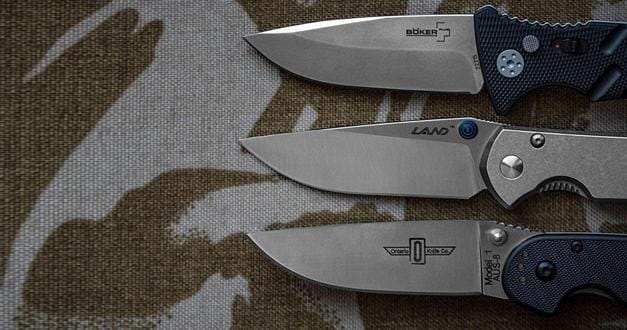
Japanese steels corresponding to the 440A, 440B and 440C types. As with the 440 series, they differ in carbon percentage. For AUS-6, this parameter is: 0.55 - 0.65% (for 440A: 0.6 - 0.75%), for AUS-8: 0.7 - 0.75% (for 440B: 0.75 - 0.95%), for AUS-10: 0.95 - 1.1% (for 440C: 0.95 - 1.2%). The Japanese steels differ from the 440x series mainly in their use of small amounts of vanadium. This element has a positive effect on the homogeneity of the steel's crystalline structure and, in higher amounts, increases the wear resistance of the blade. These steels are commonly used in low- and mid-priced knives, mainly those produced in Japan and Taiwan. A popular knife on AUS-8 steel is the Ontario RAT 1.
8Cr13MoV
Chinese knife steel equivalent to Japanese Aus-8 stainless steel (see above). Used, among others, in those Spyderco and Benchmade knives whose production is located in China. Popular knives on this steel are Sanremu.
Sandvik 12C27
A Swedish stainless steel similar in chemical composition and mechanical properties to type 440A. Thanks to appropriate smelting technology, this steel contains very few impurities and has a very fine-grained structure, which is its primary advantage. Mainly used by Scandinavian manufacturers and also quite often by Kershaw.
N690
A high-cobalt stainless steel produced by the Austrian company Böhler Edelstahl. The technical parameters of this steel are between 440C and VG10. Durable, corrosion-resistant, long-lasting sharpness. The optimum hardness for this steel is between 58 and 60 HRC. Used in the production of both lower and higher grade knives. Relatively new to the market.
ATS-34
A stainless steel produced by the Japanese conglomerate Hitachi, originally developed for the manufacture of turbine blades in jet engines. It is a modification of 440C steel with increased molybdenum content and reduced chromium content. It holds its cutting edge much better than the AUS and 440 series steels due to its higher resistance to abrasion and deformation, but is slightly more brittle. In addition, it has less corrosion resistance, which results in a tendency to surface rust when exposed to moisture for long periods of time or in aggressive environments (e.g. seawater). This steel hardens to between 59 and 61 HRC. Used in the mid-priced and expensive knife class.
ATS-55
A Japanese Hitachi steel, similar in parameters to ATS-34. It has a similar carbon content (approximately 1%), but differs in its reduced molybdenum content. Compared to ATS-34, it has significantly better corrosion resistance and is easier to machine, unfortunately at the expense of poorer sharpness retention. It is used in the low- to mid-priced knife class. Due to its parameters, which place it close to the much more popular 440C steel, ATS-55 is one of the steels that are now being abandoned.
GIN-1
A stainless steel produced by the Japanese company Hitachi, with specifications between 440C and ATS-34. Like ATS-55, it has better corrosion resistance than ATS-34 and is easier to work with, at the expense of poorer sharpness retention. It has not gained much popularity in the branded knife market. It is rarely used today.
154 CM
A stainless steel produced by the Crucible Materials corporation, which is the US equivalent of ATS-34. The only difference is a lower content of impurities in the form of the unfavourable elements sulphur and phosphorus, which was achieved by applying high technological regimes. As a result, this steel has minimally higher corrosion resistance and slightly better impact strength, i.e. resistance to cracking and spalling. This steel is hardenable between 59 and 61 HRC. Used in the mid-price and expensive knife class.
VG-10
Developed specifically for the manufacture of knives, a relatively new Japanese stainless steel with performance exceeding that of 440C steel. With a similar carbon content and slightly less chromium, this steel contains an increased amount of molybdenum and a significant admixture of cobalt. As a result, this steel is only slightly less abrasion resistant than ATS-34/154CM and at the same time has better impact strength (resistance to cracking and spalling). Unfortunately, like the aforementioned steels, it can develop surface rust under unfavourable conditions. This steel hardens to between 59 and 61 HRC. Used for the production of mid- to high-end knives.
VG-1
Steel smelted in the same smelter as Vg-10, but slightly less advanced in terms of chemical composition. Equivalent to Aus-8 steel in terms of sharpness retention and stainless strength, and used in knives by Cold Steel, among others.
BG-42
A relatively recent stainless steel similar to ATS-34, differing from it mainly in its 1.2 per cent vanadium doping for knife production. Developed at Lantrobe Labs as a steel for bearings and other critical aerospace applications. More corrosion resistant, more abrasion resistant. Due to the high vanadium doping, this steel contains very hard carbides that act like a micro-saw on the cutting edge. A knife made of this steel cuts aggressively and retains its sharpness for a very long time. The optimum hardness for BG-42 is between 59 and 61 HRC. Unfortunately, it is relatively brittle at this hardness.
S60V (CPM-440V)
Modern stainless steel produced using CPM (Crucible Particle Metallurgy) technology by the US company Crucible Materials. It is already a so-called sinter (powder steel), i.e. a material with properties and applications typical of steel, but with a chemical composition and parameters unattainable with classical smelting methods. Here, the extremely pure, powdered raw material is pressed under great pressure and temperature, so that the resulting material has a perfectly homogeneous structure. S60V contains: 2.2 per cent carbon, 17.5 per cent chromium and as much as 5.75 per cent vanadium, resulting in a steel with a corrosion resistance of 440C and higher wear resistance than high-speed tool steels. The high vanadium carbide content makes this steel cut very aggressively. Its only disadvantage is its relatively low impact strength (resistance to fracture and chipping), which means that the steel cannot be highly hardened and is only suitable for short heads. In addition, it is difficult to machine. The optimum hardness for S60V for knives is in the relatively low range of 55 - 57 HRC, which unfortunately is also the reason for its not very high resistance to plastic deformation. Used by mid- to high-end manufacturers.
S30V
A modern stainless steel, like the S60V produced with CPM technology by the American company Crucible Materials. Unlike S60V, S30V was developed specifically for the branded knife industry, and renowned knife-maker Chris Reeve was involved in its design. This steel outperforms all ATS-34 and 154 CM steels, as well as tool steel D2, with significantly better impact strength than S60V, so it is not brittle with minimally less abrasion resistance. It is suitable for both small folding knives and tactical fixed-head knives. Widely regarded as the best stainless steel on the market. Its only disadvantage is the price of the material and the cost of machining. The optimum hardness for S30V is between 58 and 60HRC. Used for blades of medium and high-end knives.
S90V (CPM-420V)
The most advanced type of stainless steel produced using CPM technology by Crucible Materials. It combines the characteristics of the two steels described above. Abrasion resistance at the level of S60V (CPM440V), while impact and corrosion resistance are the same as in S30V. Due to the high cost of the material and the very labour-intensive machining, it is only used in limited series of the most expensive knives and in custom handmade models.
SGPS
Japanese stainless steel produced using technology analogous to CPM. It is a carbide sinter (powder steel) containing 1.4% carbon, 15% chromium, 2.8% molybdenum and 2% vanadium. In terms of mechanical properties, it is most similar to S30V steel, but is slightly more resistant to abrasion and has slightly worse impact strength. The optimum hardness for this steel is approximately 62 HRC.
ZDP-189
An extreme Japanese stainless steel containing as much as 3% carbon and 20% chromium, which can be hardened to an extraordinary 67 HRC hardness for a steel. It is a sinter (powder steel) produced in a Hitachi steelworks using a technology analogous to CPM. Due to its relatively low impact strength, it is only suitable for smaller knives, usually folding knives. ZDP-189 is most often used as a core in steel laminates, thus increasing its resistance to dynamic lateral loads. It is used in the production of top-end knives.
H1
Japanese high chrome, low carbon stainless steel containing only 0.15% carbon. Specifically designed for knives and other tools exposed to prolonged contact with water. Corrosion resistance is higher than that of 420 steel. The improved mechanical properties are achieved by the addition of relatively rare elements such as nitrogen and silicon, as well as an unusually high nickel content. This steel is hardenable to a hardness of 57 - 58 HRC. It is mainly used in rescue, diving and fishing knives.
Tool and spring steels
50HS
Polish medium carbon spring steel used in the manufacture of inexpensive military and survival knives. Easy to work with, resistant to chipping and cracking. Unfortunately, it rusts easily and, due to its low abrasion resistance and relatively low hardness, loses its initial sharpness quite quickly. Hardened to a hardness of approximately 54 HRC.
1055
American medium carbon spring steel with advantages and disadvantages similar to those of 50HS steel. Mainly used for machetes and sword replicas. It has a very simple chemical composition - apart from 0.5% carbon, it contains only a small admixture of manganese, which improves impact strength.
5160
American medium-carbon spring steel, containing approximately 0.6% carbon. Unlike other such steels, it can be hardened to high HRC values. Typically used for large knives requiring very good impact strength (resistance to cracking and chipping). Due to its high susceptibility to corrosion, it requires protective coatings and/or maintenance care.
1095
A long-used US high-carbon spring/tool steel with a carbon content of 0.9 - 1.0%. Like 1055 steel, it has a very simple chemical composition. Durable, chipping resistant, relatively abrasion resistant. Professional hardening can make this steel into an excellent blade. Its main disadvantage is its susceptibility to corrosion, which is why knives made of this steel usually have protective coatings. It is used in both machetes and inexpensive military knives as well as the most expensive custom handmade knives. The optimum hardness for this steel is between 57 and 59 HRC.
SK5 (W1)
High-carbon (0.8 - 0.9% carbon) spring/tool steel used in industry for, among other things, springs, drills and wood saws. Another designation for this steel is W1. Durable, highly resistant to fracture and chipping, relatively resistant to abrasion. Used in both lower and higher grade knives. Due to its high susceptibility to corrosion, it requires protective coatings and/or maintenance care.
52100
American bearing steel containing approximately 1.0% carbon. Durable, chipping resistant and relatively abrasion resistant. As with 1095, professional hardening can make this steel an excellent blade. Mainly used in machetes and heavy duty knives. The optimum hardness for this steel is approximately 58 - 59 HRC for a knife head. Due to its high susceptibility to corrosion, it requires protective coatings and/or attention to maintenance.
0170-6C (50100-B)
A tool steel very similar to type 52100, differing from it by a slightly lower chromium content and a small admixture of vanadium. The optimum hardness for this steel is approximately 58 - 59 HRC for the knife head. Due to its high susceptibility to corrosion, it requires protective coatings and/or maintenance care.
O1
High-carbon tool steel containing, in addition to 0.85 - 1.00% carbon, other alloying elements. Hard, durable, with very good impact strength (resistance to fracture and chipping), professionally hardened, retains its sharpness for a very long time. It can be hardened to a hardness of 62 HRC. Due to its high susceptibility to corrosion, it requires protective coatings and/or maintenance. Used for the heads of higher-end knives.
CarbonV
A high-carbon tool steel used by Cold Steel. Its technical parameters place it between 1095 and O1, but the main secret of the quality of this steel lies in the selection process of the raw material (purity of the steel) and the specially developed hardening technology. At a moderate price, it is a very good steel for tactical and field knives. It requires the use of anti-corrosion coatings and/or maintenance care. Carbon V steel hardens to a hardness of approximately 59 HRC.
A2
High-carbon, high-alloy tool steel. It has very good impact strength (resistance to fracture and chipping) with higher wear resistance than 1095 steel. With an admixture of more than 5% chromium, this steel has a lower tendency to corrode than spring steels with a similar carbon content. Hardened to a hardness of 60 HRC. This steel is used in higher-end series knives as well as handmade custom knives.
M2
High-carbon, high-alloy tool steel originally used in steel cutting machines (so-called high-speed steel). Due to its high admixture of vanadium and tungsten, it has very high wear resistance and cuts aggressively. Relatively resistant to corrosion. Its only disadvantage is that it is less resistant than spring steels to fracture and chipping and very expensive to machine and heat treat. This steel is usually hardened to 62 - 64 HRC. Used in mid- to high-end knives.
D2
A high-carbon, high-alloy tool steel which is classified as semi-stainless due to its corrosion resistance. Thanks to its relatively high vanadium and high chromium content, it is highly wear-resistant and cuts aggressively. Its only disadvantages, as with M2 steel, are its lower impact strength (resistance to fracture and chipping) and high machining costs than spring steels. This steel is usually hardened to between 58 and 61 HRC. It is used in mid- to high-end knives, as well as in customised handmade knives.
S3V
High-carbon (0.8 per cent carbon) tool steel produced using CPM (Crucible Particle Metallurgy) technology by the US company Crucible Materials. It is characterised by excellent impact strength (resistance to fracture and chipping) and high abrasion resistance, thanks to its homogeneous structure, purity and almost 3% vanadium doping. Its only drawback is its high price and susceptibility to corrosion. It is mainly used in the most expensive knives handmade by the best knife-makers, usually to individual order.
S10V
A high-carbon high-speed steel produced using CPM (Crucible Particle Metallurgy) technology by the US company Crucible Materials. It is a sinter containing 2.45% carbon and almost 9.75% vanadium. It achieves several times the wear resistance of high-speed M2 steel with similar impact strength (resistance to fracture and chipping). Its only disadvantages are its high price and susceptibility to corrosion. Due to the cost of the material and the extremely labour-intensive processing, it is only used in a small number of knives handmade by the best knife makers, usually to individual order.
INFI
A medium-carbon (approximately 0.5% carbon) nitrogen steel developed and used by Busse. Its main advantages are its excellent fracture and chipping resistance, elasticity and relatively high abrasion resistance with corrosion resistance similar to stainless steels. This is achieved by replacing some of the carbon in the steel structure with nitrogen. Busse knives are among the most expensive on the market.
Other types of steel
San Mai III
A steel laminate consisting of three layers of steel welded together. The inner layer is Aus8 stainless steel hardened to approximately 57 HRC while the outer layers are 420J2 stainless steel, which reaches a hardness of approximately 54 HRC in this laminate. The relatively stiff, hard and abrasion-resistant core is stabilised by two relatively soft but resilient and high-impact layers. This significantly increases the resistance of the blade to dynamic lateral loads that arise, for example during chopping, which protects the knife from breaking.
VG10 Lam
A three-layer steel laminate of similar construction to the San Mai III. The main difference is the use of Vg10 steel hardened to 59 HRC instead of Aus8 steel. The core cladding is 420J2 steel as in the San Mai III.
3G
A three-layer steel laminate in which the core is an SGPS sinter layer with a hardness of 62 HRC and the core facings are layers of VG2 steel, similar to Aus6 type.
Damast forged
The forged steels have different mechanical and chemical properties. The usual aim is for the forged layers to form a regular yet unique pattern, which becomes visible after gentle acid etching. This very labour-intensive technique was known as far back as the time of the Roman Empire, but due to the cost of production it is used almost exclusively in the most expensive knives, often handmade by the best knife-makers, usually to individual order. Nowadays, Damascus steel has primarily an aesthetic value, but when made by a master craftsman, it will in no way be inferior or even superior to modern industrially produced steels.
Bulat/Wootz
Also referred to as crystalline damast, a material created by special smelting methods. The melting and cooling procedure creates a so-called dendrite structure, a tree-like network of hard iron carbides in a relatively soft matrix of residual material. The steel is extremely hard and wear-resistant, with relatively good impact strength (resistance to cracking and spalling). The technology for smelting boule, like forged damast, has been known since antiquity, but today only a few master craftsmen make knives with heads made of this material. It is used only in the most expensive handmade knives, usually only available on individual order.
Other (non-ferrous) materials for knife heads
Titanium (Beta-Ti)
Titanium alloys with aluminium and vanadium (e.g. Ti-6Al-4V, 90% titanium, 6% aluminium and 4% vanadium) hardened to a hardness of approximately 47 - 50 HRC. This material is strong and resistant to fracture and chipping, but is inferior to steels in terms of mechanical properties due to its low abrasion resistance and lower hardenability. Lightweight, amagnetic, completely corrosion-resistant. Used basically only in knives designed for military divers. Expensive.
Talonite
Iron-free cobalt alloy with chromium and other alloying additives. Stainless, acid-resistant, amagnetic, it has very high abrasion resistance. Its disadvantages are its relatively low resistance to cracking and chipping and its high cost in both material and machining. It is only used in the class of the most expensive knives. A material with similar properties is Stelite.
Ceramics
Modern ceramic sinter based on zirconium oxide or zirconium carbide. An extremely hard, abrasion-resistant material, yet tough and impact-resistant enough for typical knife work. Additional advantages include total corrosion resistance and chemical inertness, which is important especially when preparing certain types of food. Unfortunately, it is very easy to damage such a blade when chopping or even lightly jacking. Zirconium oxide sinters are white in colour, while zirconium carbide sinters are black in colour and have better strength and hardness. Most commonly used in kitchen knives and folding knives. Ceramic heads reach a hardness of approximately 75 HRC.
Cera-Titan
Powdered titanium sinter containing a significant admixture of hard zirconium carbide crystals and a small addition of powdered silver. It combines the advantages of titanium such as strength and impact strength with the wear resistance of ceramic sinter. In addition, it sharpens more easily than ceramic heads. 100% corrosion-resistant, lightweight, amagnetic. Used on a small scale in general-purpose folding knives.
Zytel/Griwory
Nylon reinforced with micro glass fibres. Depending on the type of nylon used, it can be more or less flexible. Very resistant to abrasion and cracking. Of course, it is no match for metal alloys, but due to its undetectability, lightness and total lack of maintenance, some companies produce knives made entirely of this material. Most often these are injection-moulded monolithic castings. Knives with similar advantages are also made from G10 laminates and carbon fibre, but these require labour-intensive machining.