Types of target reticles
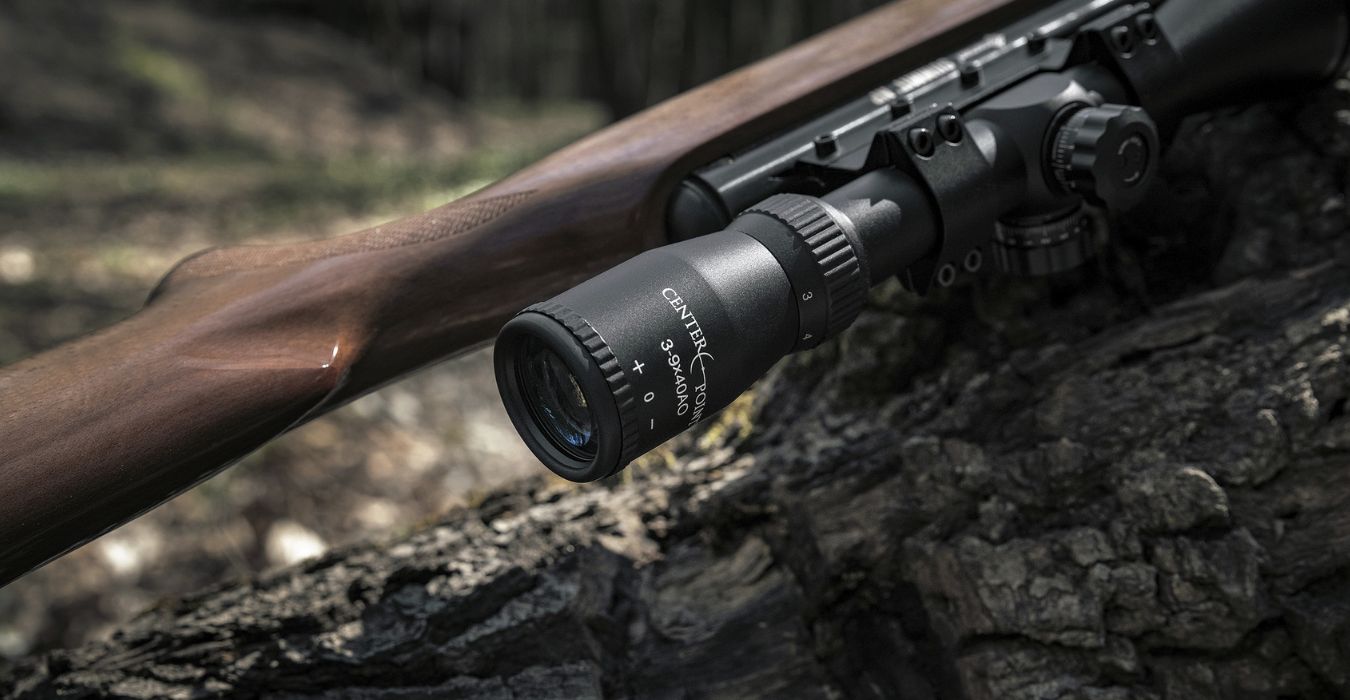
Nowadays, a large number of modern instruments equipped with various types of reticles (commonly called crosshairs) have appeared on the market for optical weapon sights (spotting scopes). Many manufacturers offer their reticles, often designed by award-winning shooters. Here we present a dozen reticles: the older type and some modern ballistic crosshairs, the most popular on the market.
A sighting reticle - this is the name of the sight located in the scope! It can be made up of various types of beams, threads, reticles and dots placed in the scope and visible when looking through it. When aiming, the blade of the spearhead or the crosshair of the threads directs the target accordingly. Horizontal or vertical beams, points, additional reticles are all aids to aiming. They can be an indicator of distance, drop etc.
Tuning of the scope - this is the alignment of the point and line of aim with the trajectory of the bullet and the point of impact.
Older nets
Grid 0
The simplest aiming reticle has no aiming threads, just a dot in the middle of the field. The reticle is practically useless in reduced visibility conditions. A version with illumination is not encountered.
Grid 1
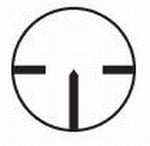
This is one of the oldest target nets, which was first used by snipers and only later found its way into hunting sights. It consists of one vertical beam ending in a spearhead with a 90-degree opening angle and two perpendicular horizontal beams. The arrowhead of the vertical beam is arranged so that its peak is at the height of the upper edges of the horizontal beams, while its sides end in the middle of their width.
A variant of grid 1 is grid 11, in which all beams taper towards the centre of the target area.
Grid 2
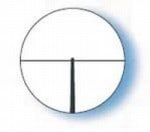
A fairly simple net in construction. Constructed of a horizontal thin thread meeting a vertical beam that tapers upwards. It is a crosshair adapted for rapid targeting of a moving target. The thin thread does not obscure the object. The net is completely useless in limited visibility conditions.
Types of crosshairs in scopes
Cross 30/30
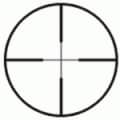
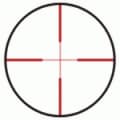
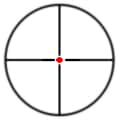
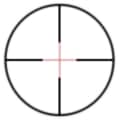
It consists of four thick arms passing into thin lines in the centre of the crosshair. This cross allows very precise aiming at all kinds of objects. Because it resembles the crosshairs used by military snipers, it is not very popular in conservative hunting circles in Europe. On the other hand, the Americans, known for their practical approach to shooting, use this crosshair for all kinds of shooting and it is probably the most popular crosshair found on scopes in the USA. It is a crosshair that is very commonly used on windage scopes and allows both precision shooting and fast, instinctive shooting in all weather and light conditions (the thick main arms help with this). The second name, the '30/30' crosshair, comes from the fact that the crosshair is designed so that the distance between the ends of the thick arms is 30 inches at 100 yards in this crosshair (usually at the standard 4x approximation). This is one of the best general purpose crosses.
The 30/30 cross is very often available with illumination. The central part (only thin threads), the whole cross, and a version with an illuminated central point may be illuminated.
The "German" cross
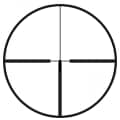
The classic 'German' cross (also known as cross number 4), is a classic arrangement of two horizontal beams on the sides and a vertical bottom beam thick with thinner (hairline) lines at the intersection. This crosshair, which has been popularised over the years, is widely used in Europe by hunters shooting with ball guns. Its advantages are first and foremost the good visibility of the crosshair in all weather conditions and in low light (e.g. during night hunting) due to the considerable thickness of the aiming beams. The open structure of the crosshair does not obscure the target and helps in the rapid pointing of the weapon, while the spike of the vertical beam allows instinctive correction when aiming at large game silhouettes. The distance between the horizontal beams is chosen in such a way that it is easier for the hunter to judge the distance to a large target, fitting his silhouette between the beams accordingly.
Cross "German 4A"
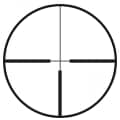
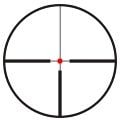
The "German 4A" cross, is an arrangement of three thick beams. Unlike the classic German cross, the vertical beam is not pointed but, like the side beams, heavily cut off.
The German Cross and the German Cross 4A often have an illumination, in the form of a point placed centrally.
Ballistic Cross
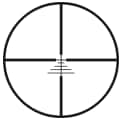
The Ballistic type target crosshair is constructed of four medium-thick beams, tapered in the middle, except that the lower thicker beam is shortened and tapered. Underneath the primary aiming mark (in the form of a thin cross) are four horizontal, thickened additional aiming marks for shooting at further distances. For a calibre 222 or 223 Rem. rifle, even of the light varmint type, such optics will be sufficient.
The reticle allows the shooter to take windage corrections.
Cross SR6 and SR12
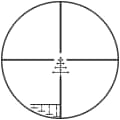
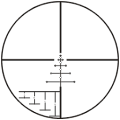
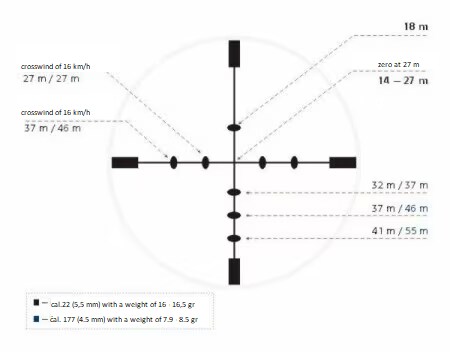
The SR type target reticle has been specially designed for hunting and Hunter Field Target competitions. It allows quick corrections to be made without having to adjust the crosshairs. This is possible thanks to the scales indicating the bullet drop points depending on the target distance and wind strength.
Obviously, these values vary depending on the calibre of the carbine and the kinetic energy of the bullet, but once the target is calibrated on the carbine, they will always be the same.
The reticle was created by Nick Jenkins, a three-time Field Target World Champion, specifically for HFT competitions where no changes to the sight settings are allowed. As a result of experimentation and analysis of shooting conditions, a reticle was created whose arms accurately indicate bullet drop points depending on the prevailing conditions affecting the bullet's trajectory.
The primary benefit of using sights with this reticle is the speed and precision of shooting at rapidly changing distances. It also does not require the shooter to make any additional calculations, as the arms of the crosshairs are arranged so that even before the shot is fired, the shooter knows what he will hit. These advantages will certainly be appreciated by competitors and hunters for whom the time to shoot is not sufficient to apply corrections.
The number of points is selected so that, for a fixed approximation, the shooter can apply a "grid" point to the predictable hit point. This avoids the tedious procedure of adjusting the sight and the associated risk of unsettling the instrument.
Mil-Dot" cross
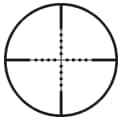
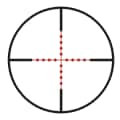
Mil-Dot crosshairs - the most complex crosshairs in rifle scopes. On the thin parts of the crosshairs, dots are placed at intervals (usually 3 or 5 MOA) to facilitate the application of vertical and horizontal corrections. This is the crosshair used in airguns by Field Target shooters because it allows distance and elevation (windage correction) corrections to be applied quickly and very accurately. The Mil-Dot reticle is currently the most widely used reticle by most sniper formations in the world. When it comes to windsocks, it is one of the best reticles for someone who is really serious about shooting (especially with a powerful PCP or fixed barrel weapon).
MAP cross
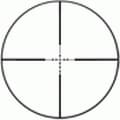
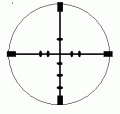
M.A.P. (Multiple Aim Point) is another development designed by Nick Jenkinson (three-time FT World Champion) for precision target shooting, taking into account relocation relative to different levels and wind strength. The points marked on the 'hair' of the reticle allow the target to be accurately aimed. The target reticle eliminates the randomness of a hit. It does, however, require the shooter to already have a great deal of experience in order to take full advantage of the benefits of this type of sighting crosshair. Of course, with such an accurate reticle, the same type of ammunition should be used, with the same weight as when shooting. Only then will it meet the expectations placed in it.